

TL;DR:
- Hotel outsourcing reduces costs by converting fixed labor expenses into variable, contract-based rates. It improves service consistency and operational flexibility, especially for standardized functions like laundry, IT, security, and accounting. Proper governance and performance monitoring are essential to achieving these benefits without compromising guest experience.
Hotel operations outsourcing is the practice of delegating specific non-core functions to specialized third parties to reduce costs, increase flexibility, and access expertise your in-house team may not have. The case for why outsource hotel operations comes down to one number: personnel costs consume 30–45% of total hotel expenses. That single line item drives most outsourcing decisions. Hotels that build a structured outsourcing strategy reduce operational costs by 15–35% while converting fixed labor overhead into predictable, contract-based rates. The result is a leaner P&L and a leadership team freed to focus on revenue and guest experience.
Why outsource hotel operations? The core financial case
Outsourcing converts unpredictable labor overhead into transparent, contract-based rates, giving finance teams cleaner cost lines. That matters most for properties operating on tight margins, where a single bad quarter in staffing costs can erase months of RevPAR gains. The shift is not just accounting cosmetics. When a department moves to a third-party contract, the hotel stops absorbing workers' compensation exposure, benefits administration, and turnover replacement costs for that function.

Third-party management also brings bench strength through forecasting systems and vendor negotiation scale that most independent hotels cannot build internally. A specialized provider buying housekeeping supplies or IT services across dozens of properties gets pricing a single hotel never will. Those procurement economies flow directly to the bottom line.
Outsourcing is not merely a cost-cutting measure. It reallocates leadership's cognitive resources toward revenue-generating activities and operational forecasting. When your general manager stops managing linen inventory and starts managing revenue strategy, the hotel performs differently.
Which hotel services are best and worst to outsource?
The decision framework most operators use evaluates three variables: guest contact intensity, operational complexity, and cost-benefit ratio per department. Low guest contact plus high standardization equals a strong outsourcing candidate. High guest contact plus brand sensitivity equals a function to keep in-house.
Strong candidates for outsourcing:
- Laundry and linen services. Fully standardized, capital-intensive, and easy to measure by turnaround time and quality score.
- IT infrastructure. Network management, PMS support, and cybersecurity require specialist knowledge most hotels cannot staff cost-effectively.
- Security. Licensed providers carry their own liability and training compliance, reducing hotel exposure.
- Administrative accounting. Payroll processing, accounts payable, and reconciliation follow repeatable workflows that third parties handle at scale.
High-risk areas to approach carefully:
| Function | Risk factor | Recommended approach |
|---|---|---|
| Front office | Direct brand touchpoint | Keep core team in-house |
| Concierge services | Relationship-driven, local knowledge | In-house with selective support |
| Food and beverage | Menu identity, guest loyalty | Retain creative control internally |
| Housekeeping | High guest contact, quality-visible | Outsource with strict SLA oversight |
Laundry, IT, security, and accounting consistently deliver the best outsourcing ROI because their outputs are measurable and their processes are standardized. Front office and guest-facing roles risk quality loss when handed to a provider who does not know your brand. The hotel check-in experience, for example, sets the tone for the entire stay. A well-managed check-in workflow is one area where brand consistency must come first.
How does outsourcing reduce costs and increase flexibility?
The mechanics are straightforward. When you employ a housekeeper directly, you pay wages, benefits, workers' compensation insurance, and training costs regardless of occupancy. When you contract a housekeeping provider, you pay for rooms cleaned. That shift from fixed overhead to variable cost is the core financial advantage of hotel management outsourcing solutions.
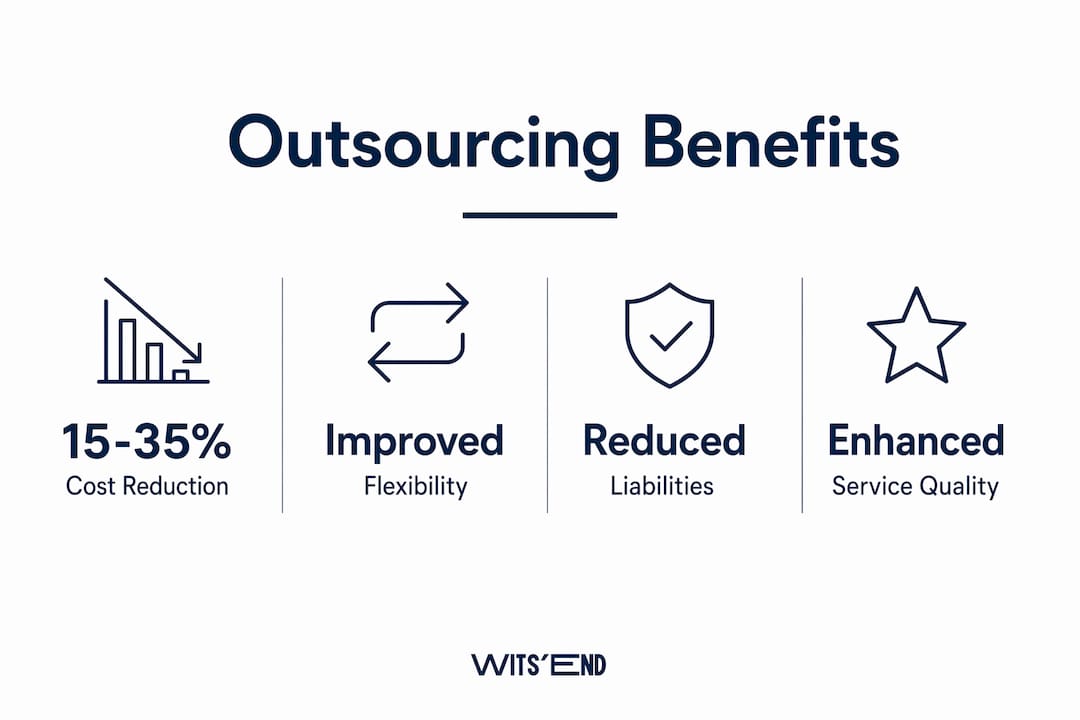
Hotels using third-party management report fewer workers' compensation claims and legal liabilities alongside improved guest response times. The liability reduction alone can be material for properties in high-litigation markets. The provider absorbs employment risk for their staff; the hotel pays a contract rate.
Economies of scale in procurement and training compound the savings. A provider managing housekeeping across 20 properties trains staff once to a consistent standard, buys supplies in bulk, and spreads management overhead across the portfolio. Your hotel benefits from that scale without building it yourself.
Key financial benefits of outsourcing hotel services:
- Fixed labor costs convert to variable, occupancy-linked contract rates
- Workers' compensation and employment liability shift to the provider
- Bulk procurement pricing on supplies and equipment
- Training costs spread across the provider's full client base
- Reduced HR administration overhead for outsourced departments
Pro Tip: Always include hidden transition costs in your cost-benefit analysis. Contract management, legal consulting, and internal coordination fees are real expenses that erode projected savings if you ignore them at the planning stage.
What are best practices for managing outsourced hotel operations?
The single biggest mistake hotels make is treating outsourcing as a set-and-forget decision. Effective outsourcing requires SLA enforcement, KPI monitoring, vendor selection, and ongoing quality audits to prevent performance degradation. The contract is not the finish line. It is the starting point.
A well-structured Service Level Agreement defines quality metrics, response time standards, and penalty clauses for non-performance. Without penalty clauses, providers have little financial incentive to maintain standards during busy periods when their resources are stretched. Build them in from day one.
Here is a practical framework for ongoing oversight:
- Define measurable KPIs before signing. Room cleanliness scores, response times, and incident rates must be agreed upon in writing, not assumed.
- Set up a performance dashboard. Real-time visibility into SLA compliance lets you catch issues before guests do.
- Schedule monthly vendor reviews. Treat the provider relationship like an internal department, not a vendor transaction.
- Build in contract flexibility. Include renegotiation windows tied to performance data, not just calendar dates.
- Maintain an internal liaison. One person on your team owns the vendor relationship and escalates issues immediately.
A hybrid model often produces the best outcome. Hybrid outsourcing combining in-house core teams with outsourced peak-period reinforcement typically yields 15% cost savings while maintaining quality. Your permanent staff carries the brand culture. Outsourced staff handles volume. The two work together under clear protocols.
Pro Tip: Structure contracts with a 90-day performance review clause. This gives you a defined exit window if quality drops without requiring you to break a long-term agreement.
How does outsourcing improve guest experience and service quality?
The assumption that outsourcing degrades guest experience is outdated. When managed correctly, specialized providers deliver more consistent service than an understaffed in-house team operating under budget pressure.
Housekeeping is the clearest example. Outsourcing housekeeping transforms the function from a black box into a data-driven process with SLA-backed quality controls. Instead of relying on a supervisor's daily walk-through, you get digital inspection reports, room-by-room completion tracking, and guest satisfaction scores tied directly to cleaning performance. That transparency is difficult to build with an in-house team unless you invest heavily in technology and management.
Specialized providers also solve the staffing flexibility problem that hurts guest experience most. During peak periods, an in-house team either burns out or falls behind. An outsourced provider scales headcount to demand without the hotel carrying those workers during low occupancy.
| Guest experience factor | In-house risk | Outsourced advantage |
|---|---|---|
| Consistency | Varies with turnover | SLA-enforced standards |
| Peak-period coverage | Overtime or shortfalls | Scalable staffing model |
| Quality reporting | Supervisor-dependent | Digital dashboards and audits |
| Training standards | Budget and time-constrained | Provider-funded, ongoing |
Outsourcing housekeeping brings specialized expertise and a digital operations approach that reduces fixed costs, improves consistency, and lifts guest satisfaction scores. The data trail also gives you evidence to address guest complaints with specifics, not apologies. For a deeper look at how operational decisions connect to the guest experience, the precision hospitality framework is worth reviewing.
Key Takeaways
Selective, well-governed outsourcing reduces hotel operating costs by 15–35% while improving service consistency, provided hotels enforce SLAs, monitor KPIs, and retain in-house control of guest-facing brand touchpoints.
| Point | Details |
|---|---|
| Cost reduction potential | Structured outsourcing cuts operational costs by 15–35% by converting fixed labor to variable contract rates. |
| Best functions to outsource | Laundry, IT, security, and accounting deliver the highest ROI with the lowest guest experience risk. |
| Hybrid model advantage | Combining in-house core teams with outsourced peak-period staff yields cost savings without sacrificing brand standards. |
| SLA enforcement is non-negotiable | Contracts must include measurable KPIs and penalty clauses; ongoing audits prevent performance drift. |
| Hidden costs matter | Contract management, legal fees, and coordination costs must be factored into every outsourcing cost-benefit analysis. |
The case for outsourcing as a leadership tool, not a last resort
Most hotel owners I talk to come to outsourcing from a place of pain. Margins are tight, a department head just left, or occupancy swings are making payroll unpredictable. That is a legitimate reason to start the conversation. But it is the wrong frame for making the decision well.
The hotels that get the most out of outsourcing treat it as a deliberate allocation of management attention, not a reaction to a staffing crisis. When you outsource laundry or IT, you are not just cutting a cost line. You are buying back hours of leadership bandwidth that were going into scheduling, compliance, and vendor management for a function that does not differentiate your property. Those hours belong on revenue strategy, guest programming, and team culture.
The hybrid model is where I land with most clients. Keep your front desk, your food and beverage identity, and your guest-facing culture firmly in-house. Outsource the functions where a specialist provider genuinely outperforms what you can build internally, and hold them accountable with contracts that have teeth. The advantages of third-party hotel operators are real, but only when the hotel maintains active oversight rather than passive hope.
The risk is not outsourcing. The risk is outsourcing without governance.
— Chris
How Wits' End Solutions supports hotel outsourcing decisions
Wits' End Solutions works with hotel owners and operators across the United States to evaluate, implement, and manage outsourcing strategies that actually hold up under real operating conditions. Our team has run the departments we advise on, which means we know where the hidden costs live and which vendor promises do not survive contact with a busy weekend.
Our task force services place experienced operators on property to assess performance gaps and build the vendor oversight structures that keep outsourced functions accountable. Our deep analytics platform gives you the KPI dashboards and SLA tracking tools to manage third-party performance with data, not guesswork. If you are weighing whether to outsource a department or restructure how you manage one, Wits' End Solutions is the right conversation to have first.
FAQ
What hotel functions are safest to outsource?
Laundry, IT infrastructure, security, and administrative accounting are the safest outsourcing candidates because their outputs are standardized and measurable. Front office and guest-facing roles carry higher brand risk and are better kept in-house.
How much can hotels save by outsourcing operations?
Hotels with a structured outsourcing strategy reduce operational costs by 15–35% by converting fixed labor expenses into variable, contract-based rates. Savings vary by property size, market, and which functions are outsourced.
What is a hybrid outsourcing model in hotels?
A hybrid model keeps core, high-guest-contact teams in-house while using outsourced staff to cover peak-demand periods. This approach typically yields 15% cost savings while maintaining service quality and brand consistency.
What should a hotel outsourcing contract include?
Every outsourcing contract should define measurable KPIs, response time standards, quality audit schedules, and penalty clauses for non-performance. Without these elements, providers have little financial incentive to maintain standards consistently.
Does outsourcing hurt guest satisfaction scores?
Outsourcing done correctly improves guest satisfaction by delivering SLA-backed consistency and scalable staffing. The risk to satisfaction scores comes from poor vendor selection and insufficient oversight, not from outsourcing itself.