
If you want to reduce hospitality turnover this quarter, put your money and attention in four places: manager quality, predictable scheduling, visible career paths, and total rewards that actually compete. Fix supervisor behavior first, since it drives more departures than pay ever will. Then tighten scheduling, publish a real path forward for hourly staff, and benchmark your total compensation. Everything below shows you how, with numbers attached.
TL;DR:
- Focusing on manager training yields the highest return, as poor supervision is the leading reason employees leave hospitality jobs, surpassing pay concerns.
- Implementing predictable scheduling with two-week notices and flexible shift options can significantly reduce turnover quickly, often within 60 to 90 days.
- Creating clear, visible career paths and structured onboarding with regular check-ins lowers voluntary attrition by demonstrating growth opportunities and support.
- Benchmarking total rewards beyond wages, including benefits and shift predictability, helps retain staff by offering better overall value than higher pay alone.
- Assigning clear ownership to turnover metrics and making retention a daily reporting practice is critical for sustained improvement, not just a quarterly HR project.
Table of Contents
- Why Retention Matters: The Financial Case for Fixing It
- What Actually Drives Staff to Leave Hospitality Jobs?
- Proven Strategies to Reduce Turnover, Ranked by Impact
- Your 30/90/180-Day Retention Roadmap
- What We See Go Wrong on Client Properties
- Retention Is a Dashboard Metric, Not an HR Side Project
- How Wits' End Solutions Helps You Cut Turnover
- Sources
- FAQ
Why Retention Matters: The Financial Case for Fixing It
Turnover rate is simple math: divide the number of separations in a period by your average headcount, then multiply by 100. Replacement cost is where operators get surprised. Recruiting, onboarding, training, and lost productivity commonly run 20% to 200% of a role's annual pay, depending on how skilled the position is.
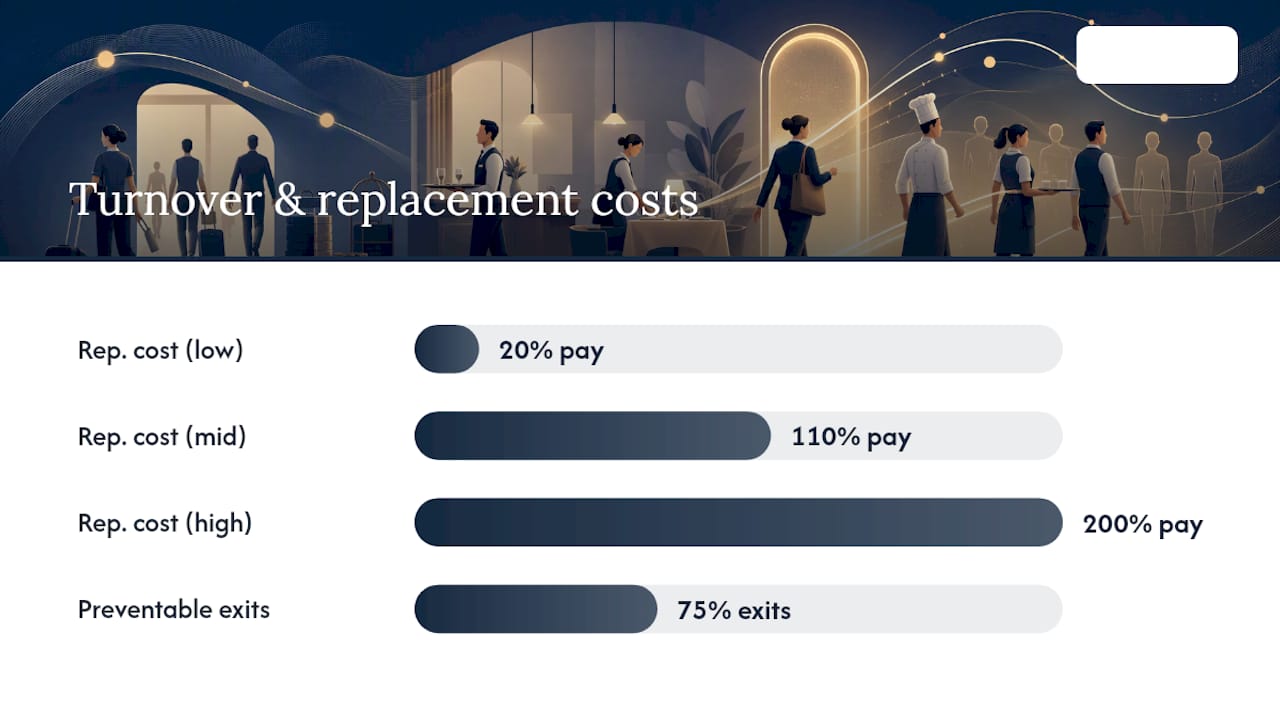
The bigger number is the one that should change how you think about this problem: about 75% of employee departures are preventable. That's not a soft HR statistic. It means three out of four exits trace back to something a manager or a system could have caught and fixed.
Track these at the property and shift level, not just annually:
| Metric | Why it matters |
|---|---|
| Turnover rate by supervisor | Isolates management quality as a variable |
| 90-day attrition rate | Flags onboarding and early-support failures |
| Voluntary vs. involuntary split | Separates culture problems from performance problems |
| Cost-per-replacement | Turns retention into a P&L line item leadership tracks |
What Actually Drives Staff to Leave Hospitality Jobs?
Before you build a retention plan, diagnose which of these are live at your property. Guessing wastes budget on the wrong fix.
- Manager quality. Poor supervision is consistently cited as the top reason employees leave restaurant jobs, ahead of pay.
- Compensation gaps. Base pay matters, but so does the full package: tips, benefits, and predictable hours.
- Unpredictable scheduling. Last-minute changes and unfair shift assignment erode trust fast, especially among staff juggling second jobs or childcare.
- No visible growth path. Hourly staff who can't see a next step tend to leave for a lateral move elsewhere rather than wait.
- Weak onboarding. New hires who feel unsupported in their first weeks quit before they ever hit full productivity.
- Low recognition and safety concerns. Feeling unseen or unsafe on shift pushes even high performers out the door.
Run this list against your exit interview data and your shift-level turnover numbers before you commit budget anywhere.
Proven Strategies to Reduce Turnover, Ranked by Impact
Not every fix deserves equal budget. Here's the order that gets you the most retention per dollar spent, based on what the data and our own client work consistently show.
-
Train frontline managers first. Manager capability is the single highest-leverage retention lever in hospitality, and training should cover communication, scheduling fairness, recognition, and conflict resolution, not just POS systems and food safety. Wits' End Solutions builds hotel and restaurant training programs around exactly these skills because a technically competent manager who can't communicate still drives people out.
-
Fix scheduling predictability before anything else operational. Two-week advance notice, a real shift-swap system, and options for compressed weeks are low-cost changes with outsized returns because they hand employees back control over their own time. EHL's retention research backs flexible scheduling, cross-training, and connecting company purpose to personal goals as core levers here.
-
Publish real career maps. A one-page path from busser to shift lead to assistant manager, with the skills and timeline attached, costs nothing to create and changes how staff think about staying. Workday's research ties visible internal mobility directly to lower voluntary turnover among your highest performers, the exact group you can least afford to lose.
-
Build structured onboarding with 90-day check-ins. A single orientation day isn't onboarding. Sequence it: day one expectations, week one shadow shifts, 30-day check-in, 60-day skills review, 90-day formal conversation about growth.
-
Benchmark total rewards, not just wage rates. Compare your full package against local competitors: base pay, tip structure, benefits, and shift differentials. A slightly lower base with better predictability often outperforms a higher wage with chaotic scheduling.
-
Install a recognition rhythm. Daily verbal shout-outs, weekly team callouts, and a documented monthly award program cost almost nothing and directly support the positive workplace experiences that the National Restaurant Association ties to retention.
-
Deploy workforce technology that actually helps managers, not replaces them. Scheduling software, pulse surveys, and attrition-risk alerts only work when a named person owns the follow-up action.
-
Make retention a reporting habit, not a project. Assign an owner, set a monthly cadence, and put turnover by supervisor on the same dashboard as revenue and food cost.
Pro Tip: Start your manager training cohort with your worst-performing shift, not your best property. That's where the data will show you the fastest improvement, and it builds internal proof the program works before you roll it company-wide.
Your 30/90/180-Day Retention Roadmap
Strategy without a timeline stays theoretical. Here's the sequence.
-
Days 1 to 30: Diagnose. Pull turnover rate, 90-day attrition, and voluntary-versus-involuntary splits by property and by supervisor. Fix the easiest scheduling complaints immediately, things like posting the schedule two weeks out. Run a quick audit of every manager's communication and scheduling habits.
-
Days 31 to 90: Execute. Launch your first manager training cohort focused on the weakest-performing shifts. Roll out structured onboarding with the 30/60/90-day check-in sequence. Pilot a recognition program on one or two properties before scaling.
-
Days 91 to 180: Scale. Formalize internal mobility with published career maps across every property. Adjust total rewards based on your benchmarking data. Integrate scheduling and pulse-survey technology so managers get attrition-risk alerts before someone quits, not after.
-
Ongoing: Measure and correct. Success looks like falling 90-day attrition and narrowing turnover gaps between your best and worst supervisors. If a metric stalls after 60 days, revisit the manager training content before you add a new perk.
What We See Go Wrong on Client Properties
Operators usually don't fail on strategy. They fail on follow-through, and we've watched the same three mistakes repeat across dozens of engagements.
- Training without accountability. A manager attends a workshop, then goes back to old habits within two weeks because nobody checks in.
- Technology without a process owner. Scheduling software gets purchased, nobody assigns who acts on the attrition-risk alerts, and the tool becomes expensive shelf-ware.
- Ignoring supervisor-level reporting. Leadership tracks company-wide turnover but never breaks it out by shift lead, missing the one manager driving half the departures.
The fix is almost always the same: a one-page career map template, a documented 90-day onboarding checklist with named owners at each checkpoint, and a manager coaching cadence of one structured conversation every two weeks, not just an annual review. Our team training work exists specifically because training that isn't paired with a follow-up structure rarely survives contact with a busy shift.
Pro Tip: If you only fix one supervisor-level problem this month, fix inconsistent shift-swap approval. Staff notice favoritism in scheduling faster than almost anything else, and it quietly drives your best people to start looking elsewhere.

Retention Is a Dashboard Metric, Not an HR Side Project
Most operators treat turnover as something HR reports on once a quarter. That framing is backwards. Retention behaves like food cost or labor percentage: it moves when someone owns it daily, and it drifts when nobody does.
My honest read on this industry is that the tools to fix turnover have existed for years. What's missing is ownership. Name a person, hand them turnover-by-shift and turnover-by-supervisor numbers, and require a one-page plan every month. Then pick one change to make this week. Posting a two-week schedule is the cheapest, fastest place to start, and it signals to your team that their time matters before you've spent a dollar on anything else.
— Chris
How Wits' End Solutions Helps You Cut Turnover
Most consultants sell you a training deck and disappear. This firm stays hands-on because its consultants have run hospitality operations themselves, not just advised on them. If manager quality is your weak point, our team trainings build the communication and scheduling-fairness skills that actually move retention. If you need eyes on attrition risk before it becomes a resignation, our advanced analytics and reporting flag the patterns a spreadsheet misses. And if you're mid-crisis with a property bleeding staff right now, our task force engagements put senior operators on-site to stabilize things fast. Every engagement flexes to what your business actually needs, from outside advice to a full operating partner on property. Visit our services page to scope an initial consult and get a plan built around your actual numbers, not a generic template.
Sources
- Work Institute 9th annual retention report
- Ways to reduce absenteeism and turnover — EHL Insights
- Prioritizing the employee experience improves retention — National Restaurant Association
- Best worker retention strategies — Workday
FAQ
What Are Seven Strategies to Reduce Employee Turnover?
The highest-impact strategies are manager training, predictable scheduling, visible career paths, structured onboarding with 90-day check-ins, competitive total rewards, consistent recognition, and workforce technology that flags attrition risk early. Prioritize manager quality first, since poor supervision is the most common reason employees leave.
What Is the 20:1 Rule in Hospitality?
There's no single, universally recognized "20:1 rule" in hospitality staffing or retention research. Ratios like this vary widely by property type and role, so treat any specific number you encounter as a rule of thumb for that source, not an industry standard.
What Are the 5 C's of Hospitality?
Definitions of the "5 C's" vary by source and aren't tied to a single agreed-upon framework in hospitality retention research. Rather than rely on an unverified acronym, focus on the documented drivers covered in this article: management quality, compensation, scheduling, career growth, and recognition.
Is 20% Employee Turnover High?
It depends on your segment, but hospitality overall runs well above many other industries, and replacing an hourly worker can cost 20% to 200% of that role's annual pay. Benchmark against your own segment and property type rather than a single national number, since quick-service, full-service, and hotel operations carry different baselines.
How Fast Can a Hospitality Business Actually Lower Turnover?
Scheduling fixes and manager accountability changes can show movement within 60 to 90 days. Structural changes like career mobility and rewards benchmarking typically need a full 180-day cycle to show up clearly in your turnover-by-supervisor data.