
A strong hospitality team is the single most controllable variable in your business's performance. Property quality, location, and pricing all matter, but poor hiring, training, and leadership are what cause most hospitality teams to fall short of expectations, driving turnover, inconsistent service, and dissatisfied guests. The U.S. accommodation and food services sector recorded an 84.9% turnover rate in 2022. That number tells you exactly how much is at stake when team-building is treated as an afterthought.
The core elements of a high-performing hospitality team come down to a short list:
- Empathy: The ability to anticipate guest needs and navigate team dynamics with emotional intelligence
- Ownership: Staff who treat guest experiences as their personal responsibility, not just a task list
- Recognition: A culture where contributions are acknowledged consistently, not only when something goes wrong
- Continuous growth: Structured pathways for learning and advancement that keep people engaged and committed
Get these four right, and turnover drops, guest satisfaction climbs, and your operation runs with far less friction.
Why building a strong hospitality team starts with defining your staffing needs

Before you post a single job listing, you need a clear picture of what your operation actually requires. Staffing models built around vague role descriptions produce vague hires. Map your service flow by shift, identify where coverage gaps create pressure points, and write job descriptions that reflect real operational demands, not generic hospitality boilerplate.
The interview process is where most managers lose ground. Behavioral questions reveal far more than a resume does. Ask candidates how they handled a guest complaint that escalated, or how they covered for a colleague mid-service. You are hiring a mindset, not a credential.

Prioritizing culture add over culture fit is one of the sharper distinctions experienced operators make. Culture fit can quietly produce a homogeneous team that struggles under pressure. Culture add means finding people who share your core values but bring different perspectives, backgrounds, and problem-solving approaches. That diversity deepens team resilience and sparks the kind of adaptability high-volume service demands.
The three traits worth screening for above all others: empathy, resilience, and curiosity. Empathy shapes how staff treat both guests and each other. Resilience determines how someone performs on hour ten of a difficult Saturday. Curiosity signals whether a person will grow with your operation or plateau.
Pro Tip: During interviews, present a real service scenario your team has faced and ask candidates to walk you through their response. You will learn more about emotional intelligence and team orientation in five minutes than a resume reveals in five pages. For a structured approach to this process, the step-by-step hiring guide from Wits' End Solutions covers behavioral assessment in detail.
How onboarding and ongoing training shape team performance
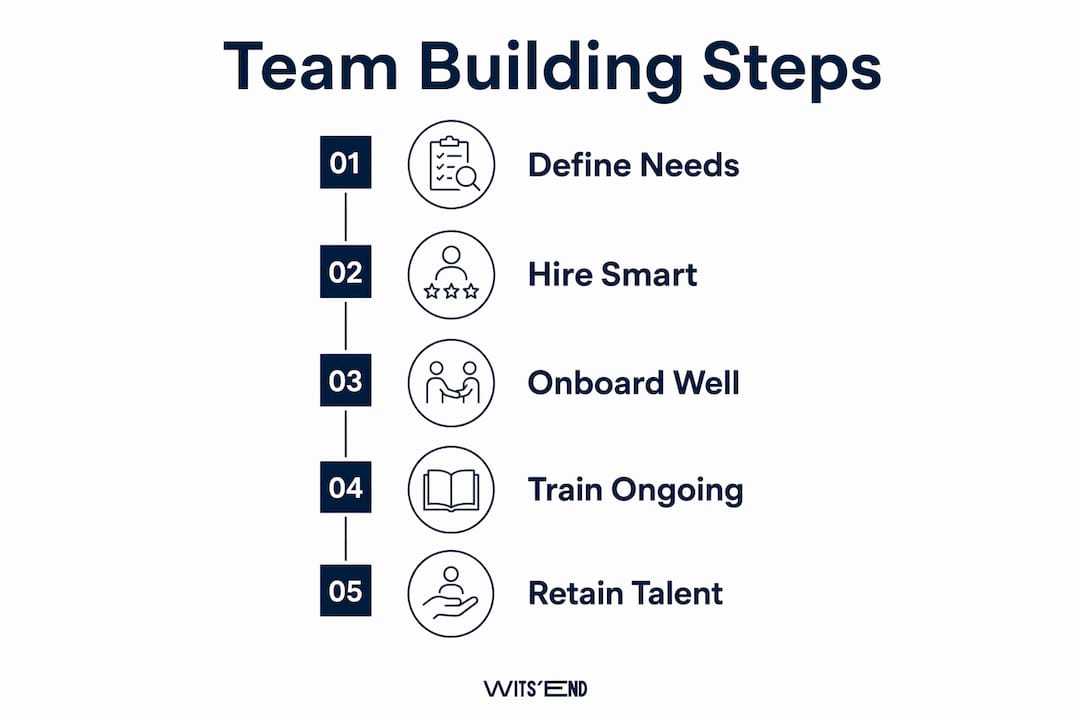
Onboarding is where your culture either becomes real or remains a poster on the wall. A structured first week should do more than cover compliance and POS training. It should show new hires how your values operate in practice, who to go to when something goes wrong, and what ownership looks like on your floor.
Effective training methods for hospitality teams include:
- Microlearning: Short, focused sessions (around 10 minutes) targeting specific skills like handling complaints or upselling without pressure
- Shadow swaps: Rotating front-of-house staff through back-of-house roles and vice versa to build cross-functional empathy and operational flexibility
- Scenario-based practice: Real service situations used as training exercises, not just orientation content
- Peer mentorship: Pairing newer staff with experienced team members for informal, ongoing coaching
Investing in employee growth through structured training programs significantly increases both retention and commitment. A LinkedIn Workplace Learning report found that 94% of employees would stay longer at a company that invested in their learning. Continuous development also signals to staff that their role has a future, which shifts the psychological contract from "just a job" to a career worth building.
Pro Tip: Build a cross-training matrix for your team so you always know who can cover which role. When a key person calls out, you want a backup squad ready, not a scramble. Wits' End Solutions' hospitality training programs are built around exactly this kind of operational resilience.
Strategies for retaining a strong hospitality team
Retention is not solved by a single initiative. It requires layering recognition, career development, compensation, and autonomy into the daily experience of working on your team.
Recognition is one of the highest-leverage tools available. According to Achievers' Workforce Institute, 63% of employees who feel recognized are very unlikely to look for a new job. That figure points to something most operators underuse: consistent, specific acknowledgment of good work, not just an annual review or an employee-of-the-month plaque.
Common retention challenges and practical responses:
- High turnover from lack of growth: Build internal mobility pathways and promote from within whenever possible
- Burnout from poor scheduling: Set clear boundaries around off-hours communication and protect days off
- Disengagement from feeling invisible: Introduce peer nomination programs and share guest feedback directly with the team members who earned it
- Compensation misalignment: Benchmark pay against current market rates and add non-cash benefits like flexible scheduling or wellness support
Cross-training functions as a retention tool as well as an operational one. Staff who understand multiple roles feel more invested in the operation's success. They also see a clearer path forward, which reduces the likelihood they will leave for a lateral move elsewhere.
How to build a team culture that drives operational success
Culture is not what you say it is. It is what your managers do when no one is watching and how your team treats each other during a difficult service. Core values only work when they permeate daily operations, not just the employee handbook.
Psychological safety is the foundation. When staff feel safe raising a problem or admitting a mistake without fear of blame, service failures get addressed at the root rather than papered over. Post-service debriefs focused on fixing systems rather than assigning fault build exactly this kind of trust over time.
Culture-building actions managers can take every week:
- Celebrate wins publicly, including small ones that guests noticed
- Encourage staff to make decisions that improve the guest experience without waiting for approval
- Share positive guest feedback directly with the individuals who earned it
- Walk the floor daily with no agenda other than connecting with your team
- Address interpersonal friction early, before it becomes resentment
Empathy within teams improves morale, deepens collaboration, and reduces bias, all of which produce a stronger working culture. Research involving hotel and restaurant employees found that perspective-taking, specifically the ability to understand a colleague's position, had a stronger effect on team performance than empathic concern alone. That distinction matters for how you structure training: teaching staff to actively consider a coworker's situation produces measurable results.
A guest-focused culture does not happen by telling staff to smile more. It happens when employees understand the meaning of their work and feel recognized for it. When those conditions exist, the quality of guest interactions follows naturally.
Expert insights on transforming hospitality teams
The most consistent finding across experienced hospitality operators is this: leadership focused primarily on task completion rather than culture building drives turnover and stalls performance gains. The shift from task overseer to culture architect is where real team transformation begins.
Structured leadership coaching that combines performance feedback, goal-setting, and self-reflection produces motivated, high-performing teams. Managers who encourage team members to assess their own performance, not just receive top-down evaluations, build a sense of ownership that carries into every guest interaction.
Leadership best practices that sustain team motivation:
- Set specific, measurable expectations so staff know what success looks like before a shift starts
- Use KPI dashboards to track guest satisfaction scores, retention rates, and service consistency in real time
- Conduct regular performance reviews that link individual growth to team goals, not just gap analysis
- Build psychological safety by modeling transparency and addressing problems without assigning blame
- Keep leaders visible on the floor, not just in the office, because presence builds trust faster than any policy
Technology plays a supporting role here, not a starring one. Automating repetitive, low-value tasks (routine guest queries, scheduling reminders, internal updates) frees your staff to focus on the human interactions that actually drive loyalty. The right tools reduce stress during lean staffing periods without replacing the personal connection that defines hospitality. The role of senior leadership in setting this tone across the operation cannot be delegated to a platform.
How to measure and evaluate hospitality team performance
Measuring team performance in hospitality requires tracking both operational outputs and the human indicators that predict long-term health. Guest satisfaction scores and online review ratings are the most visible metrics, but they are lagging indicators. By the time a score drops, the underlying team issue has usually been present for weeks.
Leading indicators give you earlier signals:
- Staff retention rate: Tracks how many employees stay beyond 90 days and beyond one year, two thresholds that reveal whether onboarding and culture are working
- Internal mobility rate: The percentage of open roles filled by internal promotions, a direct measure of whether your development investment is producing results
- Pre-shift readiness: Whether teams arrive briefed, equipped, and aligned, which reflects the quality of your daily leadership habits
- Peer recognition frequency: How often staff acknowledge each other's contributions, a proxy for psychological safety and team cohesion
Pulse surveys, run monthly or quarterly, surface problems before they become exits. Keep them short (five to eight questions) and act visibly on the feedback. Nothing erodes trust faster than a survey that produces no response from management.
Performance reviews should connect individual goals to team outcomes. A server who improves their upsell rate contributes to revenue; a front desk agent who resolves complaints without escalation protects the guest experience. Making those connections explicit in reviews gives staff a reason to care about metrics beyond their own role. Wits' End Solutions' analytics and advising services help operators build the dashboards and review cadences that make this kind of evaluation practical rather than theoretical.
Exit interviews are underused in hospitality. When someone leaves, a 15-minute honest conversation often reveals a systemic issue that a dozen pulse surveys missed. Track exit themes over time and you will find patterns that point directly to where your retention strategy needs work.
Key Takeaways
A strong hospitality team requires intentional hiring, structured development, consistent recognition, and leadership that builds culture rather than just managing tasks.
| Point | Details |
|---|---|
| Hire for culture add | Seek candidates who share your values but bring diverse perspectives to build resilient, adaptable teams. |
| Invest in training from day one | Structured onboarding and continuous development, including microlearning and peer mentorship, drive retention and commitment. |
| Recognition retains staff | 63% of employees who feel recognized are very unlikely to look for a new job, making consistent acknowledgment a core retention tool. |
| Culture is built through daily behavior | Psychological safety, visible leadership, and shared guest feedback shape culture more than any policy document. |
| Measure leading indicators | Track retention rate, internal mobility, and pulse survey results alongside guest scores to catch team issues early. |
Wits' End Solutions works with hotels, restaurants, and food and beverage groups across the United States to build, train, and retain the teams that drive operational success. Whether you need a full staffing model review, leadership coaching, or hands-on operational support, we work alongside your team at every stage. Talk to us about what your operation needs.