
A strong restaurant name starts with a locked concept, survives a digital and legal availability check, and holds up when strangers try to say it out loud. Skip any one of those three tests and you risk a rebrand within eighteen months. The next step is not brainstorming. It is finalizing your concept, because a name chosen before the concept is settled almost always gets replaced.
TL;DR:
- Owners should lock the restaurant concept first by describing its target audience, cuisine style, and price point before generating any name ideas.
- Generating 40 to 60 raw name candidates using core ingredients, location, or cultural references allows effective filtering based on spelling, signage, and searchability.
- Conducting digital and legal checks, including Google, domain, social media, and trademark searches, is essential before selecting a final name to avoid costly rebrands.
- Names should be tested for brand fit by evaluating their cuisine cues, tone, service style, and scalability to ensure they won't limit future growth or confuse customers.
- Trend-driven names should be avoided unless backed by a durable movement, and timing workshops with structured filtering help prevent costly delays and rebranding choices.
Table of Contents
- What Is the Restaurant Naming Process, Step by Step?
- How Do You Check if a Restaurant Name Is Legally Available?
- Does the Name Actually Fit Your Restaurant Concept?
- Which Restaurant Naming Trends Should You Avoid?
- What Can a Naming Workshop Teach You About Choosing a Name?
- When Should You Stop Naming and Start Building the Brand?
- How Wits' End Solutions Supports Your Restaurant Naming Process
- Sources
What Is the Restaurant Naming Process, Step by Step?
Naming a restaurant is not a single creative burst. It's a sequence, and skipping steps is exactly how owners end up printing new signage a year after opening. Here is the order that works, drawn from the same logic behind OpenTable's naming framework and adapted for how Wits' End Solutions runs naming workshops with clients.
1. Lock the concept before you touch a name. A concept is not a list of features like "farm-to-table" or "casual Italian." It is the specific intersection of what you can execute with excellence, what the market actually wants, and what keeps the P&L healthy, as DoorDash's merchant guidance on restaurant concepts puts it. Write one sentence describing your concept, your target guest, and your price point before you generate a single name idea. If you can't write that sentence yet, you're not ready to name anything.
2. Generate volume, not perfection. Once the concept sentence exists, generate as many raw ideas as possible using a few reliable techniques:
- Word association from your core ingredient, cooking method, or signature dish
- Founder, family, or location-based names (a street, a neighborhood, a grandparent's name)
- Cultural or regional hooks tied honestly to your cuisine's origin
- Controlled wordplay: one pun or rhyme, used sparingly, never stacked
Aim for 40 to 60 raw candidates in this round. Quantity matters here because filtering is where quality gets decided, not generation.
3. Filter hard, using functional rules, not vibes. Run every surviving name through these filters:
- Can a stranger spell it correctly after hearing it once?
- Does it read clearly on signage from across a street?
- Does it work in a Google search alongside your cuisine and city?
- Does it avoid relying on a font trick or accent mark to make sense?
Most lists shrink from 50 names to under 15 at this stage, and that's the point.
4. Shortlist to three to five finalists. Rank survivors by how available they are likely to be. A name that's brilliant but already trademarked in restaurant services, or already owns zero usable social handles, should drop in priority even if you love it. This is where creative instinct has to yield to practical screening.
5. Build a decision checklist and a rollout plan. Before you commit, confirm: concept alignment, spelling simplicity, digital availability, and a plan for signage, menus, and staff scripts using the new name. A short rollout plan, even a one-page outline, prevents the scramble that happens when a name gets approved and nobody has thought about how it prints on a to-go bag.
Pro Tip: Run brainstorming and filtering as separate sessions, ideally on different days. Mixing idea generation with critique kills volume, because people self-censor the moment they know a name will get judged in the same breath they say it.
How Do You Check if a Restaurant Name Is Legally Available?
Once you have three to five finalists, run them through what BrandScout calls the "digital gauntlet", followed by a formal trademark search. Do this in order, and do not skip steps because a name "feels" available.
- Google search the exact name plus your city and cuisine type. Look for existing businesses, not just similar words.
- Google Maps search the same terms to catch local competitors search alone won't surface.
- Domain check through a registrar like GoDaddy or Namecheap. A .com match matters, but a clean available domain in any extension is workable if the name itself is strong.
- Social handle check across Instagram, TikTok, and Facebook for exact or close matches.
- Marketplace and app store check, since a name that collides with an existing food delivery listing creates confusion at the worst possible moment, right when a customer is trying to order.
If a name clears the digital gauntlet, move to a formal trademark search at Uspto. Search under International Class 43, which covers restaurant and hospitality services specifically. A clear digital footprint does not guarantee legal clearance, and a name can be trademarked in Class 43 without owning a matching domain, so both checks matter independently.
If your top choice is partially taken:
- Add a geographic qualifier ("Name + City") for the domain or handle only, keeping the spoken brand name clean
- Negotiate for a parked domain, though budget for this taking weeks, not days
- Check whether the conflicting trademark actually covers restaurant services in Class 43, since a name trademarked for retail goods may not block food service use
Hire a trademark attorney once you're down to one finalist and before you sign a lease or order signage. Keep dated screenshots of every search you run. They matter if a conflict surfaces later. LegalZoom's business name guidance also recommends checking state business name availability and filing or reserving the name at the state level, a step distinct from federal trademark protection and one owners frequently forget until it delays their liquor license application.
Does the Name Actually Fit Your Restaurant Concept?
A name can clear every legal and digital check and still be wrong for the restaurant. Testing brand fit is a separate, necessary pass. Before committing, check the name against:
- Cuisine cue: does it signal what kind of food this is, even loosely?
- Tone match: does it sound like a $12 lunch spot or a $90 tasting menu, and does that match your actual price point?
- Service style alignment: does it read as counter-service casual or full-service formal?
- Scalability: will this name box you in if you add a second location, a different daypart, or a catering arm?
Run visual mockups before you finalize, since a name can read beautifully on a laptop screen and fall apart at scale, as BrandScout's naming research points out. Mock up the storefront sign, a small-print menu line, a takeaway bag, and even a short reservation script ("Thanks for calling [Name], how can I help?"). If a host stumbles saying it out loud, guests are likely to have trouble as well.
The scalability question deserves real weight. A name built entirely around one dish or one neighborhood works fine for a single location but can quietly limit you the moment you want to franchise, open a second concept, or pivot the menu. For a deeper look at how naming interacts with broader brand identity decisions, see Wits' End Solutions's guide to restaurant brand identity.
Which Restaurant Naming Trends Should You Avoid?
Trend-driven names age fast, and the traps are predictable. Watch for:
- Foreign words chosen for aesthetic sound rather than actual meaning, especially ones native speakers pronounce differently than you expect
- Overloaded cultural references that require explanation before a guest even walks in
- Trendy prefixes and suffixes ("The [Blank] Collective," "[Blank] Society") that read as current now and dated in three years
Measure spelling friction directly instead of guessing. Ask ten strangers to spell your top candidate after hearing it once. If more than one in five need it spelled out, that name has a friction problem serious enough to cost you search traffic and word-of-mouth referrals.
Trend-based names aren't automatically wrong. If you're genuinely riding a durable movement, current gastronomy trends can validate concept relevance, but pair the name with a stable visual identity so the brand survives even if the trend word feels dated in five years.
Pro Tip: If you love a trendy name but worry it'll date poorly, register it as a secondary mark or sub-brand while keeping your primary legal name and domain more neutral. This gives you an exit ramp without a full rebrand later.
What Can a Naming Workshop Teach You About Choosing a Name?
Wits' End Solutions runs naming workshops built around timed idea generation. Five-minute silent rounds, where owners and staff write candidates without discussion, consistently produce more original names than open group brainstorming, because nobody anchors on the first idea spoken aloud. Group filtering comes after, once ideas exist on paper and can't be defended by ego.
One recurring lesson from this work: names that pass the creative round often fail the availability-first filter, and owners who skip that filter early tend to fall in love with a name they later have to abandon after signage is already ordered. Building availability checks into round one, not round three, saves real money.
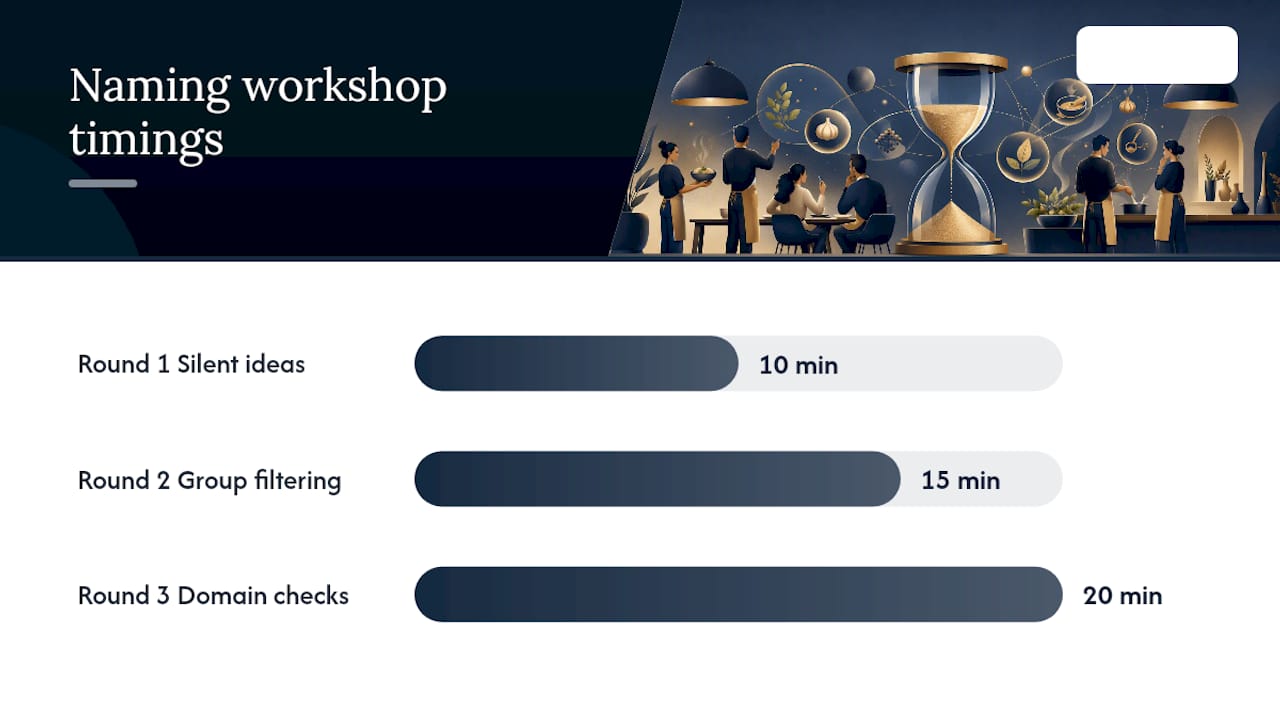
If you want to replicate this in 30 to 60 minutes:
- Round 1 (10 minutes): silent, individual word lists tied to your concept sentence
- Round 2 (15 minutes): group filtering against spelling and signage rules
- Round 3 (20 minutes): quick domain and social handle spot-checks on the top five survivors
When Should You Stop Naming and Start Building the Brand?
Analysis paralysis kills more launch timelines than bad names do. Set a firm rule: if a name clears the digital and legal gauntlet and gets a positive reaction from three authentic outside testers, that's a go signal. Stop shopping for a better option once those two conditions are met.
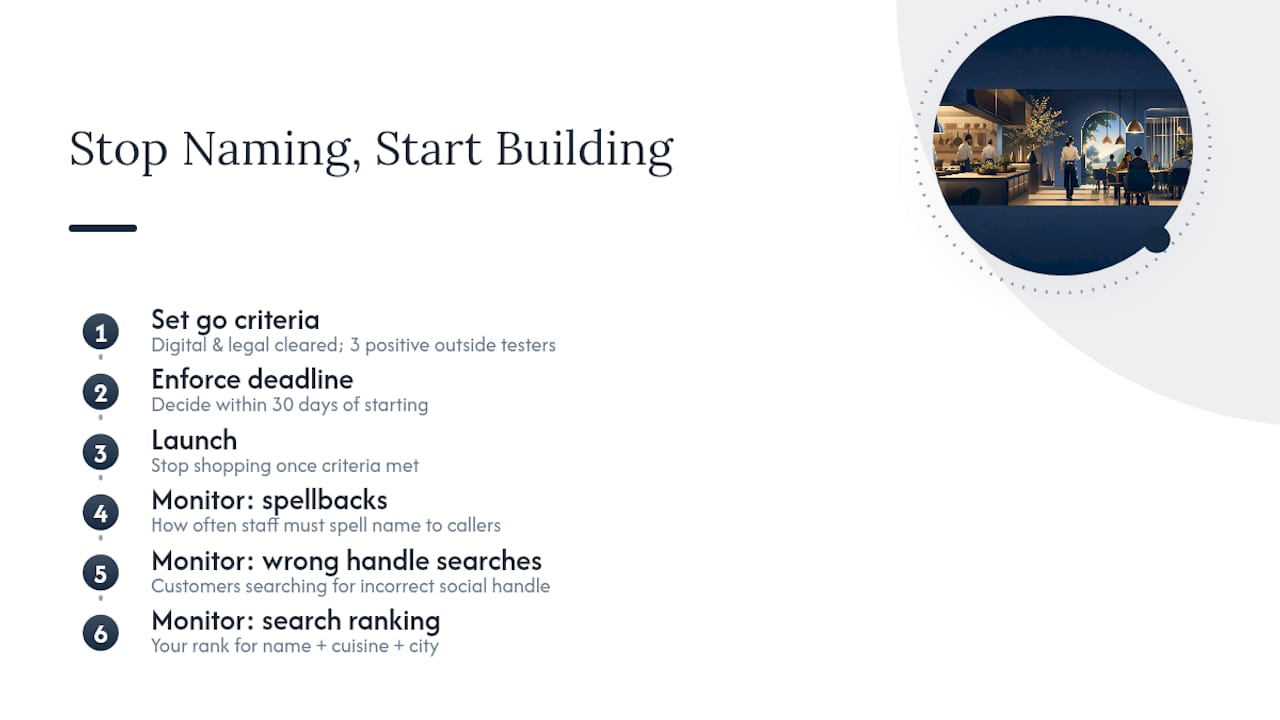
Give yourself a 30-day decision deadline from the moment you start the process. Delaying past that window rarely produces a better name. It usually just delays lease negotiations, menu printing, and hiring.
Once you've launched, watch three signals for the first 90 days: how often reservation staff have to spell the name back to callers, whether customers are searching for the wrong social handle, and where you rank when someone searches your name alongside your cuisine and city. Weak signals in any of these point to a friction problem worth addressing early, before it hardens into a habit customers associate with your brand.
— Chris
How Wits' End Solutions Supports Your Restaurant Naming Process
Running this entire process alone, on top of everything else a restaurant opening demands, is exactly where most owners lose weeks they don't have. Wits' End Solutions runs the full naming workshop for you: timed brainstorming rounds, the digital and legal gauntlet, visual mockups at signage scale, and a rollout plan that carries the name through menus, packaging, and staff scripts without the guesswork of doing it solo. This fits owners launching a new concept or rebranding an existing one who want expert facilitation instead of a spreadsheet of half-finished searches. To start, come to a consult with your concept sentence, target guest profile, and any name candidates you already like. From there, Wits' End Solutions's Brand Design & Development service handles the rest, so your name is locked, legally clear, and ready for launch on your timeline, not a delayed one.
Sources
- Restaurant branding (WebstaurantStore)
- United States Patent and Trademark Office (USPTO)
- How to name a restaurant: 10 tips (OpenTable)
- Brand naming for restaurants in 2026 (BrandScout)