
Concept development is the structured process of transforming a raw idea into a validated, actionable plan before any significant resources are committed. It sits between inspiration and execution, and it is where most products either gain their footing or quietly fall apart. The process covers user understanding, problem definition, market analysis, idea generation, visualization, evaluation, testing, and refinement, often cycling through those stages more than once before a team commits to building anything. Done well, it reduces investment risk, aligns cross-functional teams around a shared vision, and gives every downstream decision a clear anchor.
The core components of concept development:
- User understanding: Who has the problem, and how does it affect them?
- Problem definition: What specific gap or unmet need does the concept address?
- Ideation: Generating and filtering potential solutions against real constraints.
- Visualization: Translating ideas into sketches, mockups, or written propositions that others can react to.
- Testing and refinement: Exposing the concept to real feedback and adjusting before committing to full development.
What separates a concept from a raw idea?
An idea is a starting point. It is often vague, untested, and incomplete. A concept is what happens after you have done the work to define who the idea is for, why it is better than existing alternatives, how it functions, and what success looks like. The distinction is not semantic. Teams that treat ideas as concepts skip the validation work and end up building products that miss the market.
Key differentiators:
- Specificity: An idea is directional. A concept names the user, the problem, the solution, and the value proposition.
- Validation: A concept has been tested against real user feedback or market data. An idea has not.
- Feasibility: A concept accounts for technical and operational constraints. An idea ignores them.
- Readiness: A concept can be handed to a design or engineering team with enough clarity to act on. An idea cannot.
A useful illustration from the software world: "an AI-powered ticket triage system for B2B SaaS support teams that reduces first-response time by 60% through automatic classification and draft generation" is a concept. "What if AI handled support tickets?" is an idea. The gap between those two statements is exactly what concept development closes.
How the concept development process actually works
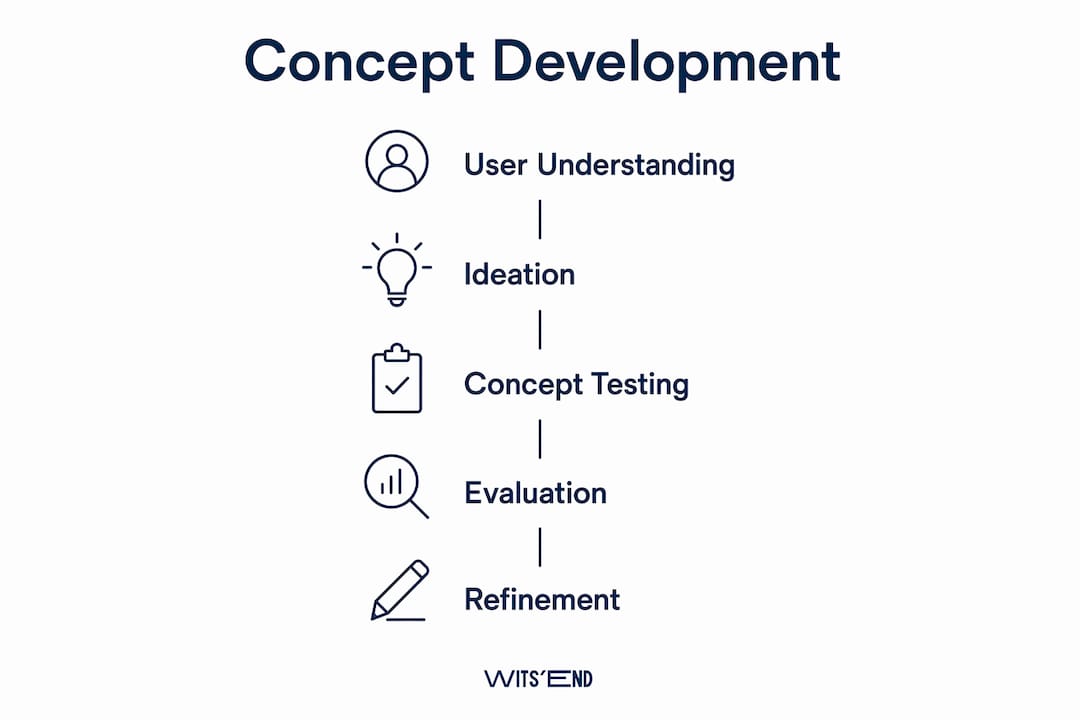
The process is iterative, not linear. Teams move through stages, loop back when new information surfaces, and only advance when the evidence supports it. These stages overlap and repeat as needed before any final development commitment is made.
The core stages:
- User understanding — Research who the end user is, what problems they face, and what they currently use to solve them.
- Problem definition — Narrow the focus to a specific, solvable problem with a defined scope.
- Market analysis — Assess competitive alternatives, market size, and positioning opportunities.
- Idea generation — Generate a broad set of potential solutions, then filter for feasibility and fit.
- Visualization — Translate the strongest ideas into written propositions, sketches, or rough prototypes.
- Evaluation — Score concepts against user needs, technical feasibility, and business viability.
- Concept testing — Expose the concept to real users or target customers and collect structured feedback.
- Refinement — Adjust the concept based on what testing reveals, then retest if needed.
- Decision-making — Make a go or no-go call based on evidence, not enthusiasm.
| Stage | Primary Objective | Key Output |
|---|---|---|
| User understanding | Map real needs and behaviors | User research summary |
| Problem definition | Narrow scope to a solvable gap | Problem statement |
| Market analysis | Identify competitive context | Competitive landscape brief |
| Idea generation | Produce and filter solution options | Prioritized idea list |
| Visualization | Make the concept tangible | Sketches, mockups, or written propositions |
| Evaluation | Score against defined criteria | Concept scorecard |
| Concept testing | Gather real user feedback | Test results and insights |
| Refinement | Improve based on evidence | Revised concept document |
| Decision-making | Commit or pivot | Go or no-go decision |
The iterative nature of this process is what separates it from a simple checklist. A team might complete user testing and discover the problem definition was too narrow, sending them back two stages. That loop is not a failure. It is the process working correctly.

Why concept development matters for product and business teams
Early validation avoids costly rework and aligns strategic focus across teams. The business case for investing in this stage is straightforward: 72% of new product launches fail to meet their revenue targets, and a weak or poorly validated concept is the primary cause. Spending time and budget on concept development is not overhead. It is risk management.
The concrete benefits:
- Risk reduction: Catching flawed assumptions before development begins costs a fraction of what it costs to fix them after launch.
- Team alignment: A clear, written concept gives engineering, marketing, and operations a shared reference point, reducing miscommunication and scope drift.
- Faster execution: Teams with a validated concept spend less time debating direction and more time building.
- Better resource allocation: Structured evaluation helps teams prioritize the concepts with the highest market potential and deprioritize the rest before money is spent.
- Stronger stakeholder buy-in: A data-backed concept is far easier to present to leadership or investors than a verbal pitch built on assumptions.
- Improved ROI: Products that enter development with a validated concept are more likely to meet revenue targets because they were built around confirmed user needs.
Best practices for effective concept development
The teams that get the most out of this process share a few habits. They stay anchored to real user data throughout, not assumptions about what users want. They write concepts in a structured format, because poorly written concepts are a leading cause of wasted good ideas. Ipsos research using eye tracking shows that consumers read a concept in a specific sequence: visuals first, then the headline, price, varieties, and finally the concept statement. That sequence should inform how you write and present every concept you test.
Practical best practices:
- Use a standardized concept template: Include a headline, core idea, body, price point, and illustration. Consistency across concepts makes feedback more reliable and benchmarking possible.
- Validate with real users, not internal teams: Internal consensus is not market validation. Get the concept in front of actual target customers early.
- Involve engineering from the start: Engineers catch feasibility problems that product and design teams miss. Bringing them in late creates expensive surprises.
- Iterate based on data: Adjust the concept when testing reveals a gap, not when someone in a meeting has a strong opinion.
- Document the reasoning, not just the decisions: Future team members need to understand why a choice was made, not just what was chosen.
- Use AI tools to accelerate feedback analysis: AI technologies integrated into concept development can analyze consumer sentiment, social trends, and market data faster than manual methods, freeing teams to focus on strategic decisions.
Pro Tip: Align your concept development process with your hiring strategy from the beginning. A clearly defined concept tells you exactly which skills you need on the team. Vague concepts produce vague job descriptions, and vague job descriptions produce mismatched hires that slow execution.
How to evaluate and select the right concept to advance
Not every concept that survives ideation deserves development resources. The evaluation stage is where teams move from "we like this idea" to "the evidence supports this concept." Concept testing evaluates whether the concept solves a need better than alternatives, whether consumers believe it will work, and whether it delivers both functional and emotional benefits. It also provides early volume potential estimates and informs pricing strategy.
Evaluation criteria:
| Criterion | What to assess |
|---|---|
| User need fit | Does the concept solve a real, confirmed problem for the target user? |
| Competitive differentiation | Is the solution meaningfully better than existing alternatives? |
| Technical feasibility | Can the team actually build this within realistic constraints? |
| Market potential | Is the addressable market large enough to justify investment? |
| Consumer believability | Do target users trust that the product will deliver what it promises? |
| Emotional appeal | Does the concept connect on a level beyond pure functionality? |
| Business viability | Does the unit economics and pricing model support a sustainable business? |
Steps for selecting which concept to advance:
- Define your evaluation criteria and weight them before scoring begins, not after.
- Score each concept against every criterion using a consistent scale.
- Run a structured concept test with target users to validate scores with real feedback.
- Incorporate feedback into a revised concept before making a final decision.
- Make the go or no-go call based on the evidence, and document the reasoning clearly.
Companies that go beyond brainstorming by incorporating rigorous analysis and consumer feedback are far more likely to identify a single high-potential concept worth advancing. The discipline of the evaluation stage is what separates teams that ship successful products from teams that ship products nobody wanted.
What hospitality teaches us about concept development
In hospitality, concept development is not a theoretical exercise. It is the difference between a restaurant that fills seats on a Tuesday and one that closes before its first anniversary. At Wits' End Solutions, we have worked with hotel and restaurant owners across the United States who arrived with a strong vision but no structured process for testing it. The ones who invested in concept and brand development before breaking ground consistently outperformed those who moved straight from idea to construction.

The hospitality industry makes the stakes of concept development unusually visible. A hotel that opens with a misaligned concept, say, a lifestyle brand positioned in a market that wants reliable business travel amenities, cannot easily pivot. The physical space, the staffing model, the pricing structure, and the marketing are all built around the original concept. Changing course after opening is expensive and disruptive. Doing the concept work correctly before the first dollar of construction is spent is not a luxury. It is the most cost-effective decision an owner can make.
Structured concept development in hospitality also aligns teams that would otherwise pull in different directions. Design, operations, and marketing each have their own priorities. A well-defined concept gives all three a shared foundation, which is exactly what Wits' End Solutions builds with clients through our hotel concept development process.
Common challenges in concept development and how to address them
The process breaks down in predictable ways. Knowing where it typically fails makes it easier to prevent.
Falling in love with the idea too early. Teams that become emotionally attached to a concept stop evaluating it objectively. The fix is to build evaluation criteria before ideation begins, so scoring happens against a standard rather than against enthusiasm.
Skipping user research. Internal assumptions about what customers want are almost always partially wrong. The only way to know is to ask real users, observe real behavior, and test real concepts with real feedback. No amount of internal debate substitutes for that.
Treating the process as linear. Teams that move through stages in a strict sequence and refuse to loop back when new information surfaces end up committing to concepts that have not been fully stress-tested. The iterative nature of the process is a feature, not a flaw.
Weak concept writing. A concept that is hard to understand produces unreliable test results. If respondents cannot grasp what the product does or why they should care, their feedback reflects confusion rather than genuine reaction. Standardized templates with a clear headline, core idea, supporting body copy, and price point solve this problem directly.
Premature resource commitment. Pressure to move fast often pushes teams to start development before the concept is validated. The cost of that shortcut shows up later, in rework, pivots, and missed revenue targets.
Tools and techniques that support concept development
The right tools depend on the stage of the process, but a few categories show up consistently across industries.
Brainstorming and structured ideation remain the starting point for most teams. Techniques like SCAMPER (Substitute, Combine, Adapt, Modify, Put to other uses, Eliminate, Reverse) and "How Might We" framing help teams generate ideas that go beyond the obvious without losing focus on the core problem.
Mind mapping works well for organizing and connecting ideas during the early stages. Tools like Miro and Mural let distributed teams build shared visual maps in real time, which is particularly useful when design, operations, and marketing are working across locations.
Concept boards and written propositions are the workhorses of the testing phase. A well-structured concept document, with a headline, core idea, supporting reasons to believe, and a price point, gives test respondents enough information to react meaningfully. Ipsos research on standardized concept formats confirms that structure directly improves the quality of consumer feedback.
Prototyping bridges the gap between a written concept and a testable product experience. Low-fidelity prototypes, paper sketches, clickable wireframes, or physical mockups let teams gather behavioral feedback before committing to full development. In hospitality, this might mean a soft opening with a limited menu, or a mock-up of a room layout tested with target guests before construction begins.
Weighted decision matrices bring objectivity to the evaluation stage. By assigning weights to criteria like user need fit, feasibility, and market potential, teams can score multiple concepts on a consistent scale and make selection decisions that are defensible and documented.
AI-assisted analysis is increasingly part of the toolkit. AI can process large volumes of consumer feedback, social media sentiment, and market trend data faster than any manual method, helping teams identify which concept attributes resonate and which fall flat. The value is not in replacing human judgment but in giving teams better information to act on.
How concept development shapes project outcomes
The impact of a well-executed concept development process shows up at every stage of a project, not just at launch. Teams that validate their concept before committing resources spend less time in development rework, experience fewer scope changes, and bring products to market with stronger initial traction.
The NATO CD&E framework offers a useful reference point outside the commercial world. NATO's approach treats concept development as a continuous evaluation cycle, where ideas are iteratively explored, tested, and refined before any capability is deployed. The principle transfers directly to product and business teams: the more rigorously a concept is tested before commitment, the lower the risk of costly failure after it.
In product design, concept development determines whether the final product actually solves the problem it was designed to address. In marketing, it shapes messaging, positioning, and channel strategy before any campaign budget is spent. In business innovation, it is the mechanism that turns a market opportunity into a viable business model with a defined customer, a clear value proposition, and a realistic path to revenue.
The compounding effect is real. Teams that treat concept development as a core discipline build institutional knowledge about what their customers actually want, what their organization can realistically deliver, and how to evaluate new ideas faster and more accurately over time. That knowledge does not disappear after a single project. It becomes a competitive advantage that gets stronger with each cycle.
Key Takeaways
Concept development is the single most cost-effective investment a product or business team can make before committing to development, because it is where flawed assumptions are cheapest to fix.
| Point | Details |
|---|---|
| Concept vs. idea | A concept defines the user, problem, solution, and success criteria; an idea does none of that. |
| Iterative process | Stages overlap and repeat as needed — looping back is the process working, not failing. |
| Validation before investment | 72% of new product launches fail to meet revenue targets, most often due to a weak or untested concept. |
| Structured concept writing | Standardized templates with a headline, core idea, body, and price point produce more reliable test feedback. |
| Team and hiring alignment | A clearly defined concept tells you exactly which skills to hire for, preventing costly mismatches. |
Wits' End Solutions works with hotel and restaurant owners at exactly this stage, before the lease is signed, before the contractor is hired, and before the brand is named. If you are building a hospitality concept and want a team that has done this work firsthand, start with our brand development services or reach out directly for a consultation.