
TL;DR:
- Hotel concept development is a strategic process that defines a hotel's identity, target guest, and operational logic before design begins. It ensures decisions are aligned across architecture, services, and branding to optimize investment, efficiency, and guest experience. A dedicated concept leader and thorough analysis prevent costly revisions and create a differentiated, high-performing hotel.
Hotel concept development is the structured strategic framework that drives every architectural, operational, and marketing decision in a hospitality project. It is not a mood board or a logo exercise. It defines who your hotel attracts, how it operates, and why guests return. A well-built concept protects your investment strategy from the first site visit to the thousandth night of service. Owners who skip this phase do not save time. They pay for it later in redesigns, operational chaos, and weak market positioning.
What is hotel concept development, and why does it matter?
Hotel concept development is the process of defining the complete identity and operating logic of a hotel before a single architectural drawing is finalized. The industry also calls this hotel project conceptualization, and the two terms are interchangeable in professional practice. The concept answers four questions: Who is this hotel for? What experience does it deliver? How does it operate? And why will guests choose it over every other option in the market?
Starting with typology shapes every downstream decision. Typology means your star rating, room mix, service model, and the ratio of public space to back-of-house. A 120-room select-service hotel in a business district has a fundamentally different concept logic than a 40-room boutique resort on the coast. Getting that definition right at the start determines your building massing, your staffing model, your P&L structure, and your brand positioning.
The concept also functions as a filter. Every decision made during design, construction, and operations gets tested against it. Does this furniture choice match the story? Does this service sequence fit the guest profile? Without a defined concept, teams default to personal preference, and the result is a hotel that feels assembled rather than designed.
What are the key components of a hotel concept?
A complete hotel concept framework contains seven interconnected components: story, people, space, identity, services, content, and channels. Each one informs the others. You cannot define your service model without knowing your story. You cannot design your space without knowing your people.
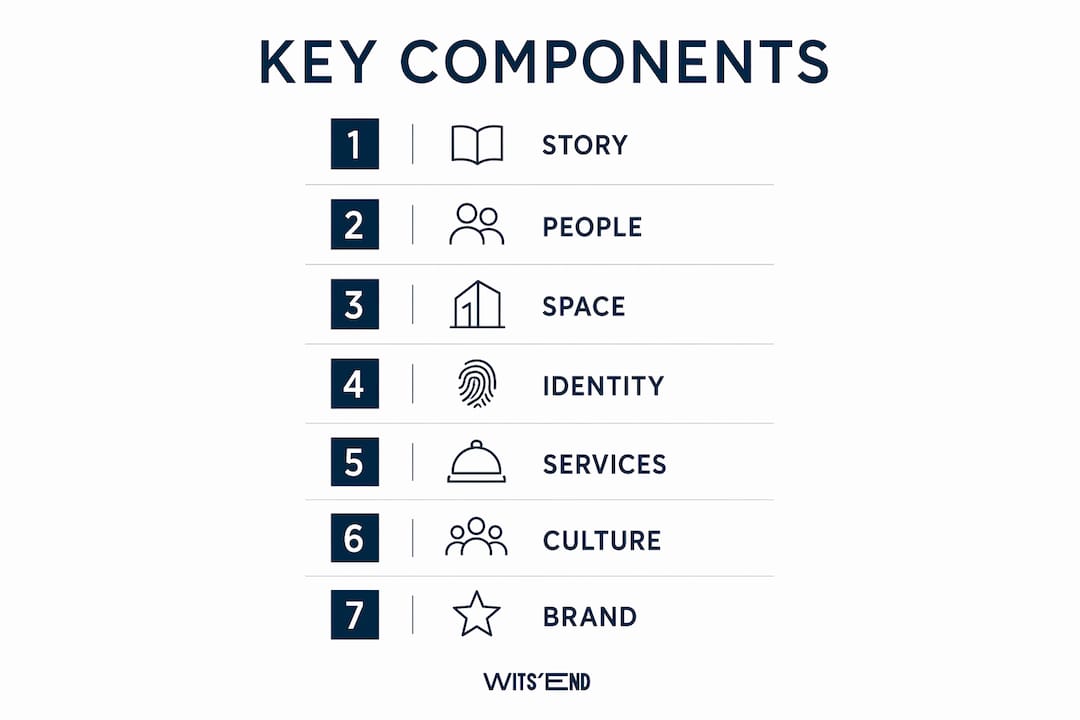
| Component | What it defines | How it connects |
|---|---|---|
| Story | The central narrative and reason for being | Drives identity, content, and channel strategy |
| People | Target guest profile and psychographics | Shapes services, space design, and staffing |
| Space | Physical layout, atmosphere, and flow | Reflects story and supports service delivery |
| Identity | Brand name, visual language, and tone | Expresses story across all touchpoints |
| Services | F&B, amenities, and operational offerings | Matches guest expectations and P&L targets |
| Content | Photography, copy, and storytelling assets | Activates identity across channels |
| Channels | Distribution, marketing, and booking strategy | Connects the concept to the right guests |
The staged process moves from typology to narrative to execution. You start with the hard structural decisions: room count, service tier, and target market. Then you build the story around those parameters. Then you translate the story into physical space, brand identity, and operational systems.
- Define typology first: star rating, room mix, and service logic.
- Build the narrative second: the central story that differentiates the hotel.
- Develop identity third: name, visual language, and brand voice.
- Design space fourth: architecture and interiors that express the story.
- Build operations fifth: staffing models, service sequences, and menus.
- Activate channels last: distribution, marketing, and content strategy.
Pro Tip: Document every concept decision in a single reference document. Call it your concept bible. Every consultant, architect, and department head should work from the same version.
How does concept development shape architecture and operations?
Typology decisions directly determine building design. Room mix and service logic affect floorplate dimensions, corridor widths, elevator placement, and the ratio of revenue-generating space to support space. A full-service hotel with a spa, multiple F&B outlets, and meeting rooms needs a fundamentally different structural approach than a limited-service property.
Brand standards add another layer of constraint. If you are developing a franchised property, obtaining the brand's PIP manual before schematic design is mandatory. These documents specify fixture counts, corridor widths (typically 1.5–1.8 meters clear), FF&E requirements, and technology standards. Missing these requirements during design means expensive revisions during construction review.
Back-of-house planning is where many first-time developers make a costly mistake. Back-of-house areas account for 15–25% of a hotel's gross floor area. That percentage represents laundry, housekeeping storage, staff facilities, receiving docks, mechanical rooms, and kitchen infrastructure. Neglecting BOH zoning at the concept stage creates operational bottlenecks that directly harm service standards and ADR.
Interior design decisions function as value engineering, not decoration. Every material, fixture, and furniture choice carries a maintenance cost, a replacement cycle, and an operational implication. Decisions made late in the process cost more and offer fewer options. The concept stage is where you lock in the design logic that makes those decisions consistent and cost-effective.
Pro Tip: Bring your MEP engineer into the design process during schematic design, not after. Mechanical, electrical, and plumbing systems consume significant floor area and ceiling height. Discovering conflicts during construction documentation is expensive.
What role does narrative play in the guest experience?
A narrative-driven approach produces better hotels than a layout-first approach. Focusing on narrative before layouts ensures that operational feasibility and guest experience alignment are built into the design from the start, not retrofitted. The story is not a tagline. It is the operating logic of the entire property.
Strong concepts integrate psychographic data alongside market research to understand target guests beyond age and income. Psychographics capture values, travel motivations, and lifestyle preferences. A guest who travels for cultural immersion has different expectations than one who travels for business efficiency. Your concept must be built around one clear guest profile, not a compromise between several.
The brand manifesto is the written expression of that story. It defines the hotel's values, its voice, and its promise to guests. Every touchpoint, from the check-in script to the role of food in hospitality to the room amenity selection, gets measured against that manifesto.
Staff are the primary medium of the brand. Value-driven staff training creates authentic guest experiences that no physical design element can replicate. Training focused on shared values produces a self-sustaining brand expressed naturally through human interaction. A hotel with a compelling story and a team that does not live it will underperform a simpler property where the team is fully aligned.
Here is the sequence for building a narrative-driven concept:
- Define the central story: one clear idea that makes this hotel distinct.
- Build the guest profile: psychographic and demographic data combined.
- Write the brand manifesto: values, voice, and promise in plain language.
- Map every touchpoint: arrival, check-in, F&B, rooms, and departure.
- Align staff training with the manifesto before opening day.
- Test the concept with 3D visualization and operational walkthroughs before construction begins.
Pro Tip: Read the brand manifesto aloud to a prospective guest before you finalize it. If they cannot describe the hotel back to you in one sentence, the story is not clear enough yet.
How do you manage the concept development process effectively?
The single most common mistake first-time developers make is starting architectural design before completing the concept. Rushing into design without thorough strategy and feasibility analysis increases both risk and cost. Every revision made during construction documentation costs multiples of what it would have cost during concept development.
The planning phase is the most cost-effective investment in the entire project. Feasibility analysis, market positioning, concept definition, and design development done properly protect the asset quality and operational performance for the life of the property. Compressing these stages is a false economy.
A concept leader is not optional. This role aligns strategy, architecture, operations, and guest experience throughout the development process. Without one, decisions fragment across consultants and departments, and the concept drifts. The concept leader holds the vision and tests every decision against it.
Common pitfalls to avoid during concept development:
- Designing for personal taste instead of the target guest profile.
- Selecting a brand flag before completing market and feasibility analysis.
- Treating the concept as a design brief rather than an operational framework.
- Skipping psychographic research and relying on demographic data alone.
- Allowing architects to drive concept decisions that belong to the operator.
Pro Tip: Schedule a concept alignment workshop with all key consultants before schematic design begins. One day of structured alignment prevents months of misaligned work.
Understanding what is guest experience at a structural level is also part of this process. The concept defines the experience. The operations deliver it. Both must be designed together.
Key Takeaways
Hotel concept development is the foundational framework that determines investment success, operational efficiency, and guest loyalty before a single wall is built.
| Point | Details |
|---|---|
| Concept precedes design | Define typology, narrative, and guest profile before architectural drawings begin. |
| Seven components connect | Story, people, space, identity, services, content, and channels must align to create a cohesive property. |
| BOH planning is critical | Back-of-house areas represent 15–25% of gross floor area and require concept-stage attention. |
| Staff carry the brand | Value-driven training produces authentic guest experiences that physical design alone cannot deliver. |
| A concept leader is essential | One person must own the vision and test every decision against the core concept throughout development. |
Why I think most hotel projects get the concept phase wrong
The pattern I see most often is owners who treat concept development as a creative exercise rather than a business discipline. They hire an architect, pick finishes they like, and call it a concept. Then they wonder why the hotel feels generic, why the staff cannot explain what makes the property special, and why RevPAR sits below market.
The properties that outperform their competitive set share one characteristic: the concept was built before anything else. The story was clear. The guest profile was specific. The operational logic was designed into the building, not bolted on after the fact. That discipline is not glamorous work. It involves market data, feasibility modeling, and a lot of iteration before anything looks like a hotel.
The other mistake I see is treating the concept as finished once the brand identity is designed. A logo and a color palette are not a concept. The concept lives in the service sequences, the staff training, the menu logic, and the room programming. Those elements require as much attention as the architecture, and they are where most of the guest experience is actually created.
Experiential travel is not a trend. Guests are choosing hotels based on what the property stands for, not just where it is located or what the rate is. A disciplined concept is the only way to compete on that dimension. Creativity matters, but creativity without strategic discipline produces beautiful hotels that do not perform.
— Chris
How Wits' End Solutions supports hotel concept development
Wits' End Solutions works with hotel owners and entrepreneurs from the first concept sketch through daily operations. Our brand design and development practice covers concept creation, brand identity, and the operational frameworks that bring a hotel story to life. We also provide deep analytics to validate market positioning and support data-driven concept decisions. For properties in active development or transition, our task force services place experienced operators on property to align teams with the concept before and after opening. If you are building a hotel and want a concept that performs as well as it looks, we are the right partner for that work.
FAQ
What is hotel concept development?
Hotel concept development is the structured process of defining a hotel's identity, guest profile, service model, and operational logic before design and construction begin. It functions as the decision-making framework for every phase of the project.
How long does hotel concept development take?
The timeline varies by project scale and complexity, but concept development typically runs parallel to feasibility analysis and precedes schematic design. Compressing this phase increases risk and downstream costs.
What is the difference between hotel branding and hotel concept development?
Hotel concept development defines the full strategic and operational framework, including typology, narrative, and guest experience. Hotel branding is one component of that framework, covering name, visual identity, and voice.
Why do back-of-house spaces matter in hotel concept planning?
Back-of-house areas represent 15–25% of a hotel's gross floor area. Poor BOH planning at the concept stage creates operational inefficiencies that directly affect service quality and revenue per available room.
When should you appoint a hotel concept leader?
A concept leader should be appointed at the start of the development process, before any consultants are engaged. This role maintains alignment across architecture, operations, and brand throughout the entire project lifecycle.