

Most restaurant operators assume that great food and friendly service are enough to build a loyal customer base. They are not. What is brand positioning for restaurants comes down to this: the specific place your concept occupies in the minds of the people you want to serve. Before a guest ever walks through your door, they have already formed an impression. Positioning shapes that impression. Get it right, and your restaurant attracts the right customers, commands stronger loyalty, and competes on something more durable than price. Get it wrong, and even a well-executed kitchen cannot save you.
Table of Contents
- Key takeaways
- What is brand positioning for restaurants, really?
- The four pillars of effective restaurant positioning
- Positioning strategy types and how to choose
- How to put positioning into practice
- Common positioning mistakes that hurt restaurants
- My take on what actually separates strong positions from weak ones
- How Witsendsolutions can help you build your position
- FAQ
Key takeaways
| Point | Details |
|---|---|
| Positioning is not branding | Positioning is the strategic place you occupy in a customer's mind; logos and colors express it but are not the same thing. |
| Operational truth matters | Your positioning must reflect what your team can consistently deliver, not just what sounds compelling in a pitch deck. |
| Narrow focus wins | The most memorable restaurants commit to a specific audience, promise, and experience rather than trying to be everything. |
| Activate it everywhere | Menu, service style, ambiance, digital presence, and staff behavior must all reinforce the same positioning. |
| Revisit and refine | Positioning is not set once and forgotten. Markets shift, and your strategy must evolve with them. |
What is brand positioning for restaurants, really?
There is a common tendency to confuse brand positioning with branding, and branding with marketing. They are related but not interchangeable. Brand positioning is the place your business occupies in a customer's mind relative to competitors, built from distinct associations and expectations. Your logo, tagline, and color palette express that position visually. Your marketing communicates it to the world. But the position itself lives in perception.
For a restaurant, this distinction matters enormously. A steakhouse that brands itself with dark wood and leather seating is making a visual choice. But its positioning is the idea that this is the place you go for a serious, celebratory meal. That idea drives decisions about price point, portion size, service formality, reservation policy, and even hiring criteria. Positioning shapes decisions across every department, from the front of house to the P&L.
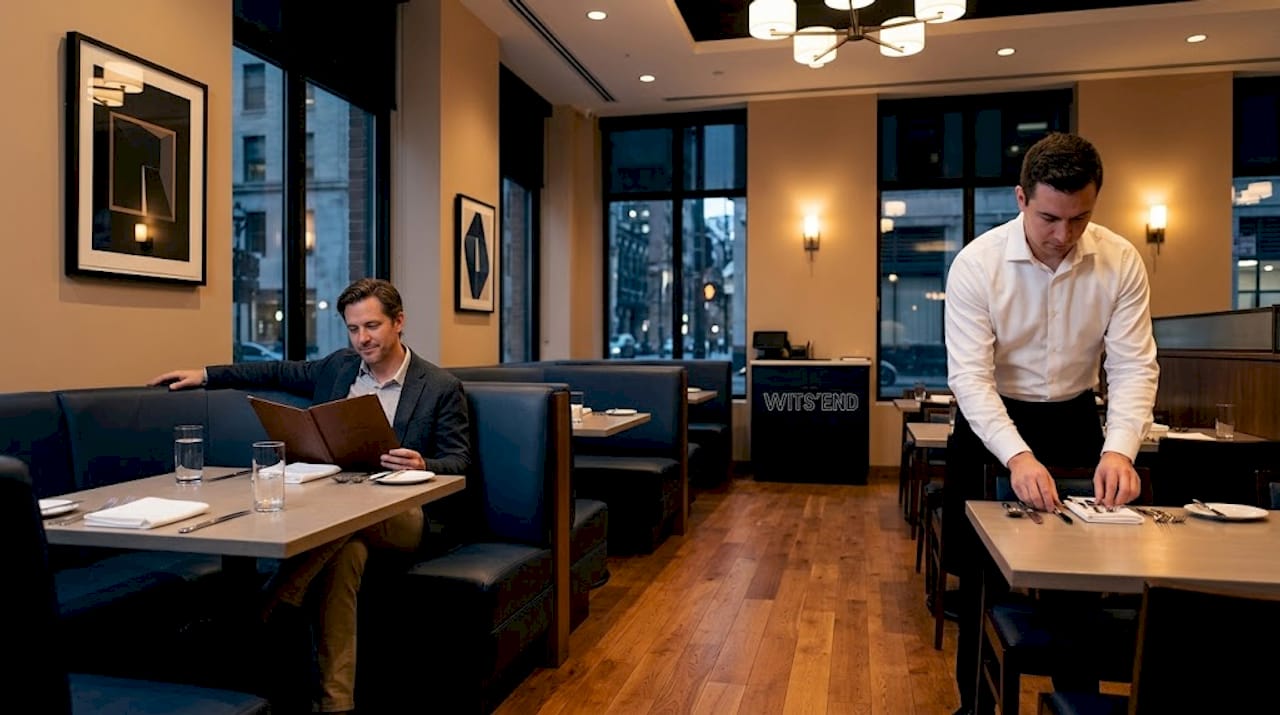
The four core questions every positioning strategy must answer are: Who are you serving? What are you offering them? Why should they choose you over alternatives? And what makes you genuinely different? These are not rhetorical. They require specific, honest answers grounded in what your restaurant can actually deliver. Vague answers produce vague positioning, which produces forgettable restaurants.
Effective restaurant market positioning also requires you to accept that you cannot be everything to everyone. A great neighborhood brunch spot is not trying to capture the fine dining anniversary crowd. Knowing who you are not serving is as defining as knowing who you are.
The four pillars of effective restaurant positioning
The 4 C's of brand positioning give restaurant operators a practical framework to evaluate and build their strategy: Clarity, Credibility, Competitiveness, and Consistency.
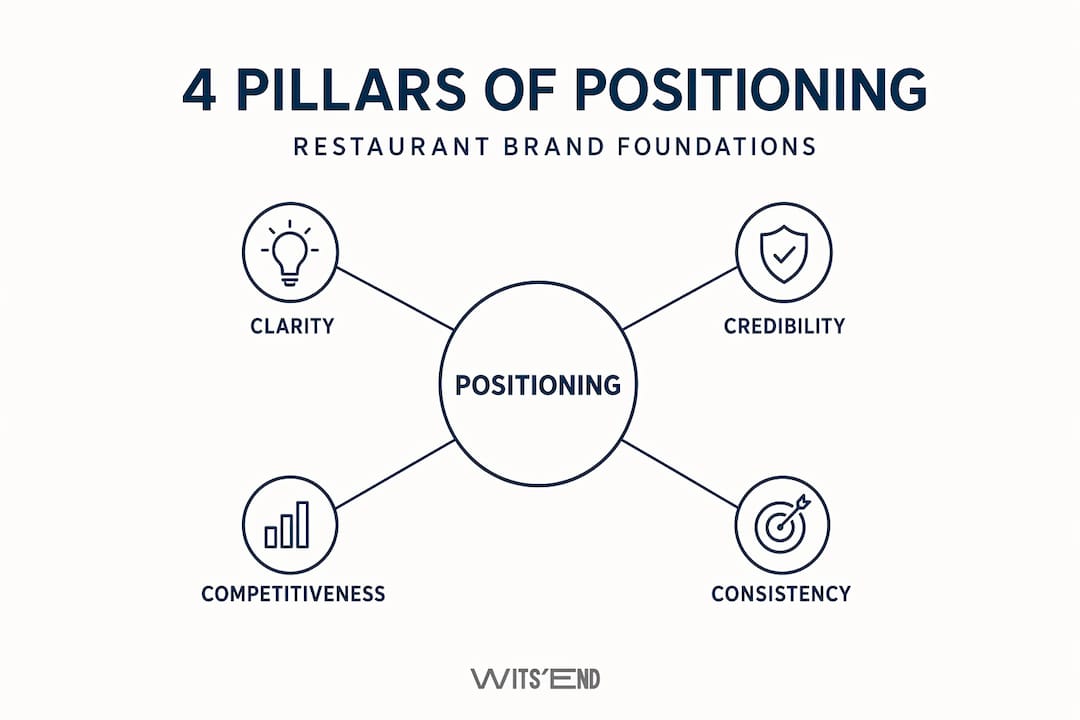
Clarity means a customer can understand what your restaurant stands for within seconds of encountering it, whether that is through your website, your menu, or your front door. Ambiguity costs you consideration.
Credibility means your positioning reflects something you can actually deliver. This is where many restaurants stumble. They position around "farm-to-table freshness" but source from the same broadline distributor as everyone else. Guests notice the gap.
Competitiveness means your position is distinct from what your direct competitors occupy. If three other restaurants in your neighborhood are all claiming "authentic Italian," that claim offers you no competitive ground. You need to find a position that is genuinely unoccupied or substantially better executed.
Consistency means every touchpoint reinforces the same story. The design, the music, the language on your menu, the tone of your Instagram captions, the way a server introduces themselves — all of it should feel like it comes from the same brand.
One of the clearest examples of restaurant branding done well is the concept of narrowing focus completely. Smash Guys focused solely on smash burgers, embedding that single-product commitment into every aspect of their communication and environment. There was no ambiguity about what they were. That clarity is a competitive asset most multi-category menus cannot manufacture.
Pro Tip: Before writing a positioning statement, list five things your restaurant will deliberately not be or not offer. That constraint exercise often reveals your actual position faster than any brainstorming session.
Positioning strategy types and how to choose
Understanding the types of positioning available to you helps you make a deliberate strategic choice rather than defaulting to what feels familiar. Four main positioning strategies apply directly to restaurants: competitive, product-focused, situational, and perceptual.
| Strategy type | Core focus | Best use case | Example |
|---|---|---|---|
| Competitive | Direct comparison to rivals | Crowded markets with clear category leaders | "The freshest sushi in midtown, at half the price" |
| Product-focused | Specific dish, ingredient, or technique | Single-concept or specialty restaurants | A Detroit-style pizza brand built around one format |
| Situational | Occasion or context of visit | Catering to specific dining moments | Upscale quick-service for the lunch hour business crowd |
| Perceptual | Emotional association and identity | Experience-driven or lifestyle brands | A neighborhood café positioned around community belonging |
Each approach has merit, and the right choice depends on your market, your operational strengths, and your guest profile. Competitive positioning works well in dense urban markets where guests are actively comparing options. Product-focused positioning suits operators with a genuine culinary differentiator they can defend. Situational positioning is underused and powerful. Owning a specific occasion, whether that is the solo work-from-café culture, the first-date spot, or the family celebration destination, creates strong recall because guests associate you with a moment in their lives.
Market research is not optional here. Spend time understanding what positions your direct competitors already occupy before you claim one. If you do not know what the restaurant three blocks away is telling its guests, you are guessing at your own differentiation. Restaurant branding that ignores the competitive context is branding in a vacuum.
Pro Tip: Survey your current guests on what one word or phrase they would use to describe your restaurant. If the answers are scattered, your positioning is not landing. If they cluster around something you did not intend, you have discovered where your brand actually lives.
How to put positioning into practice
Knowing your position and living it are two different disciplines. Here is a practical sequence for turning positioning into consistent guest experience across every touchpoint.
- Write a positioning statement. Keep it internal and specific. A strong statement covers your target guest, your core promise, and your key differentiator in three sentences or fewer. It is a tool for decision-making, not a tagline.
- Audit your menu through a positioning lens. Every item should either reinforce your position or have a strong operational reason to exist. A "farm-fresh" concept with a frozen mozzarella sticks appetizer has a credibility problem.
- Align your environment. Ambiance is not decoration. Music tempo, lighting levels, table spacing, uniforms, and even the smell of the space communicate your brand. Consistency across every touchpoint builds trust and reinforces differentiation.
- Train your team on the brand story. Your servers and hosts are the most direct channel your positioning has. If they cannot articulate why your restaurant is different in natural conversation, the guest will never feel it. This is where brand identity for restaurants gets activated or abandoned.
- Extend positioning to digital. Your website, social media, Google Business profile, and third-party listings should all reflect the same voice, visual tone, and promise. A beautifully designed restaurant with a generic, stock-photo-heavy website sends a mixed signal.
Positioning influences hiring and training as well. If your concept is built around warm, community-driven hospitality, you hire for warmth and train to reinforce it. A technically proficient but cold server is a brand misfit in that environment, regardless of their skills.
Pro Tip: Create a one-page brand reference document for your team. Include your positioning statement, three words that describe the guest experience you are delivering, three words that describe what you are not, and two examples of how each service moment should feel. Post it in your back-of-house and revisit it at every new hire orientation.
Common positioning mistakes that hurt restaurants
Most positioning failures fall into a few predictable patterns. Recognizing them before they take root can save you significant time and revenue.
- Aspirational positioning without operational support. Positioning that outpaces delivery destroys trust faster than no positioning at all. If your brand promises handcrafted, slow-food experiences but your kitchen turns tables in 40 minutes under a stressed team, guests will feel the contradiction.
- Generic claims that no one owns. Words like "authentic," "fresh," "local," and "passionate" appear on thousands of menus. They are not positions. They are adjectives. A position requires specificity.
- Inconsistent execution across locations or channels. Growth without clear brand discipline leads to inconsistent brand experiences that erode the trust you built. A second location that feels different from the first one confuses returning guests and dilutes what made the original worth revisiting.
- Treating positioning as a one-time project. Markets shift, competitors enter, and guest expectations evolve. Your positioning needs periodic review. Think of it as a living business asset, not a completed task.
If you are unsure whether your positioning is working, look at your repeat visit rate, your review language, and what guests tell people when they recommend you. Those signals tell you what your brand actually stands for in the real world.
My take on what actually separates strong positions from weak ones
I have worked with enough restaurants to see this pattern clearly. The operators who struggle most with positioning are the ones who try to define their brand by what they want to be rather than what they can genuinely deliver every service, every shift, without exception. Aspiration is useful for direction. It is not a substitute for operational discipline.
The restaurants I have seen build real loyalty and real pricing power share one trait: they committed to something specific and held it. Not forever without refinement, but long enough to let it compound. Effective brand positioning for eateries is not about being clever. It is about being clear and then staying clear under pressure.
I also see operators treat a brand refresh or repositioning exercise as a visual project, new logo, new colors, new website photos. Those things matter, but they are downstream of the strategic question. If you have not answered who you are for and why you are different in terms your team can repeat and your guests can feel, the visual work will not carry the weight you are putting on it.
Position with discipline. Test it against reality. Adjust when the data tells you to, not when you get bored with it.
— Chris
How Witsendsolutions can help you build your position
If you are working through what your restaurant's position should be, or if you have a position on paper that is not translating into guest experience, that is exactly the work Witsendsolutions does. Our team has built concepts from the first sketch and repositioned established brands that had drifted from their original clarity.
Our brand design and development service covers the full arc from positioning strategy through visual identity, menu framing, and staff training alignment. We also bring deep analytics capabilities to help you understand how your current positioning is actually landing with guests. If you want to explore restaurant branding ideas that go beyond surface-level design, or need a partner to help you build it from the ground up, we are ready to work alongside your team at whatever stage you are in.
FAQ
What is brand positioning for restaurants?
Brand positioning for restaurants is the specific place your concept occupies in a customer's mind relative to competitors. It is defined by the unique promise you make, the guest you serve, and the consistent experience you deliver across every touchpoint.
How is brand positioning different from branding?
Branding refers to the visual and verbal expressions of your identity, such as your logo, name, and design system. Brand positioning is the underlying strategic idea those expressions communicate. You can rebrand without repositioning, but you cannot have credible branding without a clear position.
Why does brand positioning matter for restaurant success?
Brand positioning influences pricing strategy, staffing decisions, menu development, and marketing all at once. Restaurants with clear positions attract the right guests more efficiently and build loyalty that price-based competition cannot easily undercut.
How often should a restaurant revisit its positioning?
Positioning is a continuous process that should be reviewed at minimum annually, or any time you open a new location, change ownership, experience a significant shift in your guest mix, or see a major competitor enter your market.
What is the biggest mistake restaurants make with brand positioning?
The most damaging mistake is positioning around attributes that operations cannot consistently support. Claiming a premium, artisan experience and then delivering inconsistent quality breaks guest trust in a way that is very difficult to recover from.