

Menu engineering is defined as the structured, data-driven analysis of each menu item's contribution margin and popularity, followed by strategic redesign of pricing, placement, and descriptions to maximize restaurant profitability. The formal discipline, developed by Michigan State University professors Donald Smith and Michael Kasavana in 1982, gives operators a repeatable framework for turning menu decisions into measurable profit gains. Rather than relying on intuition or periodic price increases, menu engineering uses sales data and cost analysis to identify exactly which items drive profit and which ones quietly drain it. Restaurants that apply this discipline consistently report profit increases of 10% to 23% within the first 90 days of implementation.
What is menu engineering and how does it work?
Menu engineering is built on two core metrics: contribution margin and popularity. Contribution margin is the dollar amount a menu item contributes to covering overhead after food cost is subtracted from its selling price. Popularity, often called menu mix percentage, measures how frequently a given item is ordered relative to total covers during a defined period. Together, these two numbers tell you far more than food cost percentage alone ever could.
Calculating contribution margin correctly requires detailed recipe costing. That means accounting for every ingredient in a dish, including garnishes, condiments, and plating components that operators routinely overlook. Incomplete recipe costing distorts contribution margin figures and leads to misclassifying items in the analysis. A dish that looks profitable on paper may actually be dragging down your margins once you factor in the lemon wedge, the side sauce, and the parsley sprig.

The data source for popularity metrics is your POS system. Modern POS platforms like Toast, Square for Restaurants, and Lightspeed generate item-level sales reports that make menu mix calculations straightforward. The key is selecting a representative time window, typically four to twelve weeks, that reflects normal trading patterns rather than a holiday spike or a slow January.
Contribution margin focus provides better profitability insight than traditional food cost percentage because it measures actual dollars earned per sale, not a ratio. A $6 pasta dish at 28% food cost contributes $4.32. A $32 steak at 38% food cost contributes $19.84. The steak looks worse by percentage but is dramatically more valuable to your P&L.
Pro Tip: Before running your first menu engineering analysis, audit your recipe cards for completeness. Pull three random dishes and cost them from scratch, including every garnish and condiment. If the numbers differ from your existing records by more than 5%, your entire analysis will be built on inaccurate data.
How to categorize menu items using the four-quadrant matrix
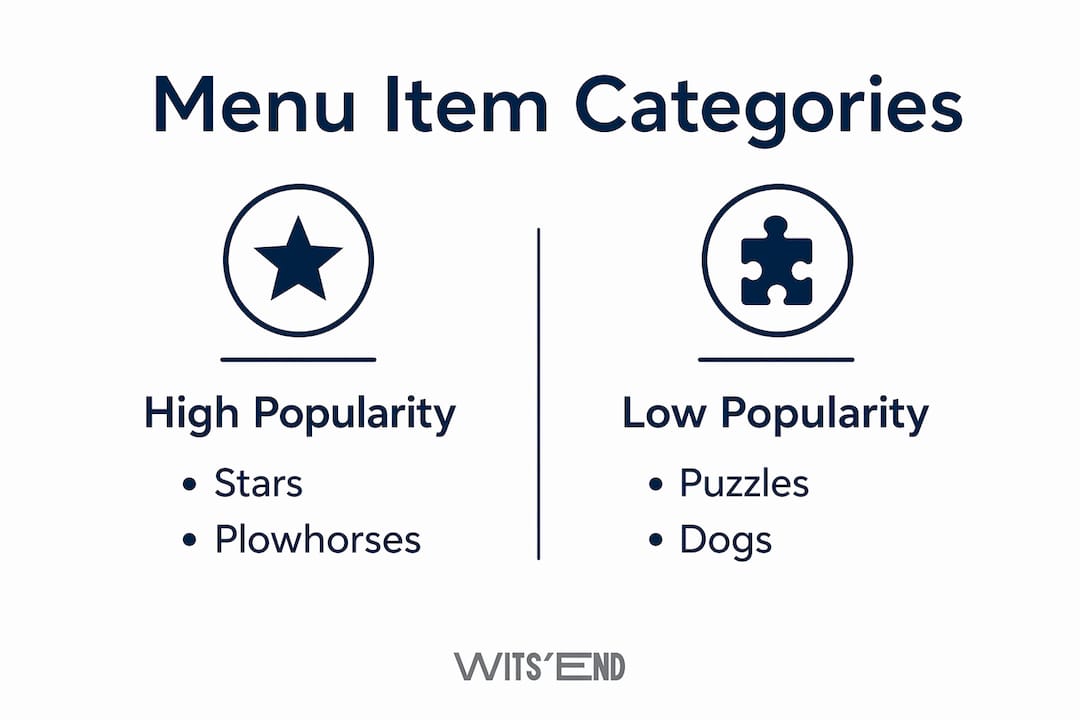
The menu engineering matrix is a 2x2 grid with popularity on one axis and contribution margin on the other. Every item on your menu falls into one of four quadrants, each with a distinct name and a corresponding action plan. This framework, popularized by Smith and Kasavana, remains the standard categorization method used by operators and consultants worldwide.
| Category | Popularity | Contribution Margin | Recommended Action |
|---|---|---|---|
| Stars | High | High | Feature prominently, protect the recipe |
| Plowhorses | High | Low | Reprice, reduce portion cost, or reposition |
| Puzzles | Low | High | Reposition, rename, or promote more aggressively |
| Dogs | Low | Low | Remove, rework, or replace entirely |
Stars are your best performers on both dimensions. They sell frequently and generate strong margins. Your job is to protect them. Do not change the recipe to cut costs, and do not bury them on the menu. Give them the best real estate on the page.
Plowhorses sell well but leave too little margin behind. A classic example is a burger that guests love but that costs too much to produce at its current price. The fix is usually one of three things: raise the price modestly, reduce the portion or ingredient cost without degrading the experience, or reposition it so a higher-margin item gets ordered alongside it.
Puzzles are high-margin items that guests rarely order. Often the problem is visibility or description, not the dish itself. Renaming a "Braised Short Rib" to "Slow-Braised Prime Short Rib with Roasted Bone Marrow Jus" and moving it to a featured position can shift a Puzzle toward Star status within a single menu cycle.
Dogs require honest evaluation. Some belong on the menu for operational reasons, such as a vegetarian option that satisfies a segment of your guests even if it rarely sells. Others are simply taking up space and prep time. Remove or rework them without sentiment.
How to implement menu engineering step by step
Putting menu engineering into practice follows a clear sequence. Skipping steps, particularly the costing phase, is the most common reason operators get unreliable results. Breaking the process into steps simplifies execution and makes the analysis repeatable.
- Select your time window. Pull four to twelve weeks of sales data from your POS system. Avoid periods distorted by unusual events.
- Cost every item. Build or update recipe cards for every dish, including all components. Use current supplier invoices, not estimates.
- Calculate contribution margin and popularity for each item. Determine your average contribution margin across the menu to set your high/low threshold.
- Categorize items into Stars, Plowhorses, Puzzles, and Dogs using the matrix.
- Redesign the menu based on your findings. Apply pricing adjustments, update descriptions, and reposition items on the page.
- Measure the impact. Run the same analysis after four to eight weeks and compare contribution margin per cover and overall menu profitability.
Menu design decisions during step five carry more weight than most operators realize. Strategic use of visual cues such as boxes, bold fonts, and photography draws guest attention to high-margin items. Pricing psychology also plays a role. Removing dollar signs from prices reduces the perception of cost. Pricing an item at $18.95 instead of $19.00 creates a psychological anchor that influences ordering behavior. Placement matters too. Eye-tracking research consistently shows that guests focus first on the upper-right corner of a two-panel menu, making that position prime real estate for a Star or a high-margin Puzzle you want to promote.
Seasonal updates are not optional. Ingredient costs shift throughout the year, and a dish that qualified as a Star in summer may become a Plowhorse by winter if your produce costs spike. Regular menu engineering analysis keeps your categories accurate and your pricing aligned with current costs.
Pro Tip: Train your servers to recommend Stars and repositioned Puzzles by name. A server who says "The short rib is incredible tonight" converts a Puzzle into a sale. Pair your menu redesign with a server upsell training session so the floor reinforces what the menu is designed to do.
Common misconceptions about menu engineering
The most persistent misconception is that menu engineering is either cosmetic menu design or a justification for raising prices across the board. Menu engineering uses sales and cost data to make targeted, evidence-based decisions. It is not about making the menu look prettier or adding 10% to every price point.
A second misunderstanding involves food cost percentage. Many operators manage their menus entirely through this metric, flagging any dish above 30% as a problem. The limitation is that food cost percentage ignores volume and absolute dollars. Percent food cost alone can mislead because a high-percentage item that sells 200 covers a week may contribute more total profit than a low-percentage item that sells 20.
Consider these common pitfalls that undermine menu engineering results:
- Costing recipes without updating supplier prices, which makes contribution margins inaccurate within weeks of the analysis
- Using a time window that includes a catering event or holiday period, which skews popularity data
- Treating the matrix as a one-time exercise rather than a recurring quarterly or seasonal review
- Failing to account for item interdependencies, such as a Dog that anchors a profitable prix fixe package
"Menu engineering's power lies in harmonizing pricing, design, and placement to influence customer decisions beyond raw numbers." — IFBTA
Menu engineering also works best when it connects to your broader F&B optimization strategy. Redesigning a menu in isolation, without aligning your server training, purchasing decisions, and operational flow, limits how much of the potential profit gain you actually capture.
Key takeaways
Menu engineering is the most direct tool a restaurant operator has for converting existing sales volume into higher profit, without adding a single cover.
| Point | Details |
|---|---|
| Contribution margin drives decisions | Measure dollars earned per sale, not food cost percentage, for accurate profitability analysis. |
| Four-quadrant matrix guides action | Classify every item as a Star, Plowhorse, Puzzle, or Dog and apply a specific strategy to each. |
| Accurate costing is non-negotiable | Include every garnish and condiment in recipe costs or your entire analysis will be unreliable. |
| Design and placement amplify results | Use visual cues, pricing psychology, and prime page placement to steer guests toward high-margin items. |
| Menu engineering is ongoing | Revisit your analysis every season to stay aligned with shifting ingredient costs and guest preferences. |
Why menu engineering is more than a spreadsheet exercise
I have worked through menu engineering analyses with operators at every level, from single-unit independents to multi-property groups, and the pattern I see most often is this: the operators who treat it as a one-time project get a short-term bump and then drift back to their old margins. The ones who build it into their quarterly rhythm see compounding gains year over year.
What surprises most people when they first go through the process is how many of their instincts are wrong. The dish the chef is proudest of is often a Puzzle or a Dog. The item the owner wants to remove because it feels dated is sometimes a quiet Star. The data has a way of humbling everyone in the room, and that is exactly the point.
The other thing I would push back on is the idea that menu engineering is a back-office function. The menu is your most powerful sales tool. It is in the hands of every guest before a server says a word. When your Stars are positioned well, your descriptions are specific and sensory, and your pricing removes friction, the menu does a significant portion of your selling for you. That is not a design trick. That is a system working the way it should.
Staying current with your analysis also gives you a real competitive advantage. Most operators in any given market are not doing this work with any regularity. When your menu is calibrated to current costs and guest behavior and theirs is not, you are operating with a cleaner P&L and a sharper guest experience. That gap compounds over time.
— Chris
How Witsendsolutions supports your menu profitability goals
Witsendsolutions works with restaurant and hotel operators across the United States to build menus that perform as hard as the teams behind them. Our work on menu creation combines recipe development, contribution margin analysis, and design strategy into a single process that moves from concept to measurable result.
For operators who want deeper support, our analytics and advising platform connects POS data to ongoing menu performance tracking, so your engineering analysis stays current without requiring a manual rebuild every quarter. We also offer business optimization services that integrate menu engineering into your broader operational and financial strategy. If you are ready to turn your menu into a profit-driving tool, we are ready to work alongside you.
FAQ
What is menu engineering in simple terms?
Menu engineering is the process of analyzing each menu item's profitability and popularity, then redesigning the menu to sell more of the items that generate the most profit. It uses sales data and recipe costs rather than guesswork.
How is contribution margin different from food cost percentage?
Contribution margin measures the actual dollar profit per item sold, while food cost percentage measures the ratio of ingredient cost to selling price. Contribution margin gives a clearer picture of which items genuinely drive profit at volume.
How often should a restaurant run a menu engineering analysis?
Most operators benefit from a full analysis every season, roughly four times per year, to account for ingredient cost changes and shifts in guest ordering patterns. At minimum, run the analysis whenever you update your menu or change suppliers.
What are the four categories in the menu engineering matrix?
The four categories are Stars (high popularity, high margin), Plowhorses (high popularity, low margin), Puzzles (low popularity, high margin), and Dogs (low popularity, low margin). Each category calls for a different pricing, placement, or removal strategy.
Can menu engineering work for small independent restaurants?
Menu engineering applies to any restaurant with a POS system and recipe cost data, regardless of size. A single-unit operator with 30 menu items can complete a full analysis in a few hours and see meaningful margin improvements within one menu cycle.