

TL;DR:
- Menu revamping is a strategic process that boosts profitability by 10-18 percent within 90 days through menu engineering and design. Digital menus reduce update costs and enable real-time adjustments, improving cost control and freshness. Regular reviews and staff training ensure menu decisions increase margins while maintaining guest satisfaction.
A restaurant menu is a commercial instrument, not a static list of dishes. It controls food costs, shapes brand perception, guides customer decisions, and directly determines your margins. Yet most operators treat a menu update as a cosmetic exercise rather than a financial one. Menu revamping, or what the industry more precisely calls menu engineering, is the disciplined process of analyzing and restructuring your offerings to maximize contribution margin and guest satisfaction simultaneously. The operators who do this consistently outperform those who don't, often by a measurable distance.
Why revamp restaurant menus? The commercial case
The clearest reason to update your menu is profit. A disciplined menu engineering process can lift restaurant profitability by 10–18% without adding covers or new items. Most operators see that improvement within 90 days of applying the framework. That number deserves attention: it means the margin you're leaving on the table right now is recoverable through analysis and repositioning, not through higher volume or capital investment.

Menu engineering works by separating your dishes into four categories based on popularity and contribution margin. Stars are high margin and high volume. Plowhorses are popular but low margin. Puzzles are high margin but rarely ordered. Dogs are low margin and low volume. Each category demands a different response: promote stars, reprice or reformulate plowhorses, reposition puzzles, and remove or rework dogs. This framework, developed by Michael Kasavana and Donald Smith at Michigan State University, remains the foundation of professional menu analysis.
Beyond item mix, a menu revamp addresses portion sizing and ingredient management. Both directly affect food cost percentage. When portions are clearly communicated on the menu, guests order more accurately. Portion-size clarity reduces unintentional food waste by helping guests better estimate what they are ordering. Less plate waste means lower food cost and a better guest experience.
- Profit lift: Menu engineering delivers 10–18% profitability improvement for most operators within 90 days.
- Cost control: Reformulating low-margin dishes with ingredient substitutions protects margin without raising prices.
- Waste reduction: Clear portion descriptions and familiar reference objects on menus reduce over-ordering and plate waste.
- Check average: Digitally enabled menu engineering can increase average check size by 12–18% through strategic item placement and upsell prompts.
Pro Tip: Before your next menu update, pull your POS data and rank every dish by contribution margin, not revenue. The dish generating the most sales is rarely the one generating the most profit.
How does menu design impact customer decisions?
Menu design directly influences what guests order. The layout, item count, and visual hierarchy of your menu are not aesthetic choices. They are sales decisions. Simpler menus with 5–7 items per category improve scannability and reduce decision fatigue, guiding guests faster and toward high-margin items.
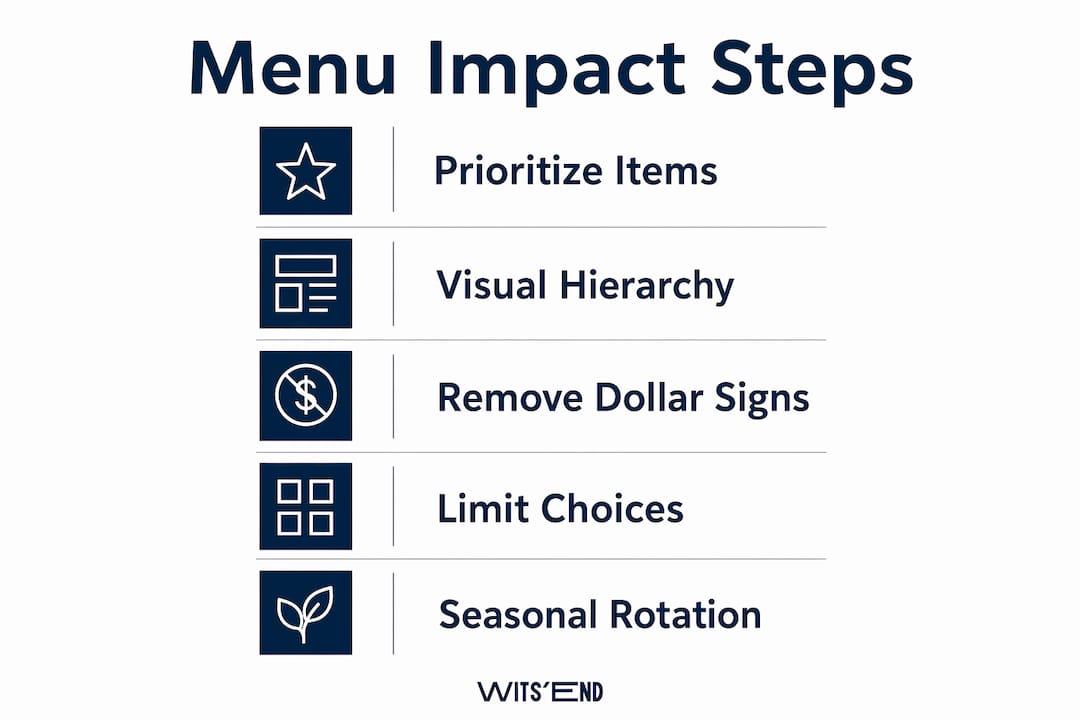
Eye-tracking research shows that guests scan menus in predictable patterns. The upper right corner of a two-panel menu receives the most attention. Placing your highest-margin items in that zone, with clear descriptions and no dollar sign on the price, consistently increases their selection rate. Removing the dollar sign reduces price sensitivity because it breaks the mental association between the number and money leaving a wallet.
An outdated or cluttered menu signals neglect. Guests read a messy menu as a proxy for kitchen quality. Outdated pricing and design erode customer trust and hurt financial performance. A menu that lists 60 items across six categories tells your guest that your kitchen is unfocused. A menu with 30 well-chosen items tells them you know what you're doing.
- Reduce item count: Cap categories at 5–7 items to cut decision friction and improve ordering speed.
- Use placement intentionally: Position high-margin dishes at the top of each category and in the upper right panel.
- Write descriptions that sell: Specific, sensory language increases perceived value without raising prices.
- Align design with brand: A fine-dining menu printed on cheap paper sends a contradictory signal. Every design element should reinforce your brand identity.
Pro Tip: Remove dollar signs from your menu prices. Research in hospitality psychology consistently shows that guests spend more when prices appear as numerals without currency symbols.
Are seasonal and digital menu updates worth the effort?
The cost argument for frequent menu updates changed completely when digital menus became standard. Traditional print menus cost $5,000–$15,000 or more per year in reprint expenses. Digital menus cost around $500 per year. That is a 10–30x reduction in update costs, and it removes the primary operational barrier to frequent iteration.
| Factor | Print menus | Digital menus |
|---|---|---|
| Annual update cost | $5,000–$15,000+ | ~$500 |
| Time to implement a price change | Days to weeks | 30 seconds |
| Seasonal rotation speed | Quarterly at best | Real-time |
| Multi-location consistency | High error risk | Synchronized automatically |
| POS integration | None | Full integration available |
Seasonal menu rotation does more than keep things fresh. It gives you pricing power. Ingredients sourced at peak season cost less and taste better. Guests respond to limited-time items with higher urgency and willingness to pay. A summer corn bisque or a fall short rib special carries perceived value that a year-round menu item cannot replicate.
Digital menu workflows also eliminate version drift across locations. When a price changes or an item is 86'd, every location and every language version updates simultaneously. That synchronization prevents the margin erosion and guest complaints that come with inconsistent print menus and delayed updates.
What are the common pitfalls in a menu revamp?
The most expensive mistake in menu revamping is confusing popularity with profitability. A dish that sells 200 covers a week can still destroy your margin if its food cost is too high. Menu engineering separates profitability from popularity by focusing on contribution margin per dish rather than revenue. Operators who skip this step often promote their worst-performing items simply because guests order them frequently.
- Audit before you act. Pull 90 days of POS data and calculate contribution margin for every item before making any changes.
- Retrain your team. A menu revamp requires staff retraining and expectation resets to avoid service friction and margin dilution. Servers who don't understand new items cannot sell them.
- Use choice architecture. The order in which items appear, and how portions are described, subtly guides guests toward better choices for both your margin and their satisfaction. Choice architecture in food service supports sustainability goals while maintaining guest satisfaction.
- Don't automate blindly. Menu engineering software accelerates analysis, but the final decisions on reformulation, repositioning, and removal require human judgment about your specific kitchen, team, and guest base.
- Set a review cadence. Quarterly reviews maximize sustained profit gains and reduce operational friction. A menu revamp is not a one-time event.
Pro Tip: When removing a popular but low-margin item, brief your front-of-house team before the new menu launches. Give them a replacement recommendation to offer guests who ask. This prevents service friction and protects the guest relationship.
Key takeaways
Menu revamping is a continuous operational discipline that directly improves profitability, reduces waste, and sharpens the guest experience through engineering, design, and digital tools.
| Point | Details |
|---|---|
| Engineering drives profit | A structured menu engineering process lifts profitability by 10–18% within 90 days. |
| Design shapes decisions | Limiting categories to 5–7 items and using placement intentionally increases high-margin item sales. |
| Digital menus cut costs | Switching from print to digital reduces annual update costs by 10–30x and enables real-time changes. |
| Popularity is not profitability | Always evaluate dishes by contribution margin, not sales volume, before promoting or removing them. |
| Revamping requires retraining | Every menu change must include a staff briefing to prevent service friction and protect margins. |
The case for making menu revamping a quarterly habit
I've worked with operators who treat their menu like a lease agreement: something you sign and then forget about for years. That approach is expensive. The restaurants I've seen make the most consistent margin improvements are the ones that put menu review on the calendar the same way they schedule P&L reviews. Quarterly is the right cadence for most operations. It aligns with seasonal ingredient cycles, gives you enough POS data to make confident decisions, and keeps your team engaged with the product.
The operators who resist this usually cite two reasons: time and cost. Digital menus have eliminated the cost argument entirely. The time argument is harder, but the math is clear. A quarterly review that takes two days of focused work and delivers even a 5% margin improvement on a $2 million revenue operation returns $100,000 annually. That is not a time problem. That is a priority problem.
The other thing I'd push back on is the idea that menu changes confuse guests. Guests don't memorize your menu. They respond to what's in front of them. A well-executed seasonal update with a trained team behind it reads as attentiveness, not instability. The menu creation process that drives both profit and experience is one that treats the menu as a living document, not a finished product.
— Chris
How Wits' End Solutions supports menu revamping
Wits' End Solutions works with restaurant operators across the United States on menu engineering, brand development, and the operational systems that make menu changes stick. Our analytics work through the Ingest platform gives operators the contribution margin data they need to make confident decisions, not guesses. Our brand design and development services align your menu presentation with your hospitality identity, so every design choice reinforces what you're trying to communicate. And our training programs embed menu optimization into your team's daily operations, so the gains from a revamp don't erode the moment the new menus hit the tables. If you want a partner who has done this work firsthand, reach out to Wits' End Solutions to start the conversation.
FAQ
How often should a restaurant revamp its menu?
Quarterly reviews are the standard for operators who want sustained profit gains. Each review should include POS data analysis, ingredient cost checks, and at least one seasonal rotation.
What is menu engineering and how does it differ from a redesign?
Menu engineering is the financial analysis of each dish by contribution margin and popularity. A redesign addresses layout and visuals. Both are part of a full menu revamp, but engineering drives the profit outcomes.
Can a menu revamp reduce food waste?
Clear portion-size communication on menus reduces over-ordering and plate waste. Portion clarity helps guests estimate what they need without guesswork, which lowers avoidable waste without requiring operational changes.
How much does switching to digital menus save?
Annual print menu costs run $5,000–$15,000 or more. Digital menus cost around $500 per year, and price changes take 30 seconds to implement across all locations.
What is the biggest mistake operators make when revamping menus?
Promoting high-volume dishes without checking their contribution margin. A popular dish with a high food cost actively erodes profit. Always run the engineering analysis before deciding what to feature or remove.