
Choose a short in-person intensive to move from line supervisor to manager; choose a cohort-based executive certificate to move to property-level management; choose a multi-module or degree program to reach regional director or owner-operator level. Each path has a different credential, time commitment, and cost structure.
- Short in-person intensive (1–2 days): Fastest confidence-builder for emerging supervisors. FIU's Emerging Leaders Program is a 2-day format built precisely for this stage.
- Executive certificate (cohort-based, 4–12 weeks): Structured, faculty-led, and often carries continuing-education credits (CEUs) or SHRM/HRCI recertification hours. Cornell's Hospitality Leadership certificate is a well-known example.
- Industry certification or apprenticeship: Recognized by employers for specific operational competencies; best for professionals who need a credential without a full academic commitment.
- Degree or multi-month executive program: Suited to candidates targeting senior property roles or ownership; combines operational, financial, and leadership coursework over a semester or longer.
- Bespoke corporate training: Delivered on-property for teams; content is tailored to your brand standards, KPIs, and staff mix.
Key Takeaways
Matching your program choice to your exact career stage is the single decision that separates training that advances your career from training that fills a line on your resume.
| Point | Details |
|---|---|
| Match program to career stage | Supervisors need short intensives; managers need executive certificates; directors need multi-module or degree programs. |
| Applied practice is non-negotiable | Programs with workplace projects and simulations produce measurable behavior change; quiz-only formats rarely do. |
| Credential type determines value | CEUs and university certificates carry more weight in hiring reviews than course-completion certificates from unaccredited providers. |
| Self-leadership comes first | EHL research identifies self-awareness as the foundational skill; programs that skip it produce managers who can run a shift but not develop a team. |
| Wits' End Solutions builds bespoke programs | Wits' End designs on-property training tied to your KPIs, from single-workshop engagements to ongoing retainer coaching across the United States. |
Table of Contents
- What hospitality leadership training actually covers
- Core modules and leadership skills you should expect
- Which program type fits your role right now
- Delivery formats, timelines, and what programs cost in the U.S.
- What credentials and continuing-education credits are actually worth
- How well-designed programs actually work
- How to evaluate and choose the right program
- How Wits' End Solutions delivers leadership development
- What most training programs get wrong, and what actually works
- Wits' End Solutions can build your team's leadership program
- Sources
What hospitality leadership training actually covers
Hospitality leadership training in the U.S. spans five distinct program types, and confusing them is the most common planning mistake operators and emerging managers make.
University executive certificates are cohort-based, faculty-led programs typically delivered online over 4–12 weeks. They award a named certificate and often carry CEUs or academic credit. Cornell's eCornell platform is the most widely recognized example in this category.
Short in-person intensives run 1–3 days and focus on practiced behaviors rather than theory. They are run by university continuing-education divisions, industry associations, and hospitality schools. FIU's Hospitality Executive Education program is a strong U.S. example. These programs accelerate decision-making confidence in compressed timeframes, which makes them a practical first step before enrolling in a longer certificate.
Industry certifications and apprenticeships are administered by bodies such as the American Hotel & Lodging Educational Institute (AHLEI) or through registered apprenticeship programs. They tend to be competency-based, employer-recognized, and renewable.
Degree programs and multi-month executive tracks combine operational, F&B, and leadership training in a structured curriculum. The Culinary Institute of America's hospitality management bachelor's degree is one example of a program that integrates applied placements with academic credit.
Bespoke corporate training is designed and delivered for a specific property or group. A consulting or operations firm builds the curriculum around your brand standards, staffing model, and current performance gaps. No two programs look the same, and the outcomes are directly tied to your operation's KPIs.
Quick reference by program type:
- Executive certificate: High credibility, moderate time (4–12 weeks), moderate cost, CEU-eligible
- Short intensive: Low time commitment, fast ROI on confidence, lower cost, no academic credit
- Industry certification: Employer-recognized, competency-based, renewable, variable cost
- Degree/executive track: Highest depth, longest commitment, highest cost, full academic credit
- Bespoke corporate: Highest relevance to your operation, no transferable credential, cost varies by scope
Core modules and leadership skills you should expect
EHL research identifies self-leadership — specifically self-awareness and self-management — as the foundational capability that underpins every other leadership skill in hospitality. Programs that skip this module and jump straight to operations frameworks tend to produce managers who can run a shift but struggle to develop their teams.
Here are the modules that appear consistently across well-designed programs, along with what you can actually do on the job after completing each:
- Self-leadership and self-awareness: You can identify your default stress responses, adjust your communication style under pressure, and set a personal development plan. Applied as a reflective journal or 360-degree feedback exercise.
- Team coaching and performance conversations: You can run a structured one-on-one, document performance gaps, and deliver feedback that changes behavior. Often delivered as a role-play simulation.
- Psychological safety and retention: You can design a team environment where staff report problems early. Adaptability and psychological safety are now listed as core hotel management competencies, not soft extras.
- Service excellence and guest experience: You can map the guest cycle, identify failure points, and build a recovery protocol. Partner resources on guest experience frameworks offer practical models for this module.
- Operations and P&L basics: You can read a labor cost report, identify a variance, and present a corrective action to ownership. Typically delivered as a case study with real property data.
- Revenue and yield awareness: You can interpret an occupancy and ADR trend, understand RevPAR, and connect daily decisions to the weekly P&L.
- Change management and small experiments: You can design a PDSA-style test (Plan-Do-Study-Act), run it with your team, and report results. This is the module most likely to be a field assignment.
- Digital fluency: You can navigate a property management system (PMS), a point-of-sale (POS) platform, and a guest messaging tool. Hospitality industry trends increasingly require leaders to work alongside AI-driven tools, and programs that omit this module are already behind.
A 2025 study of experienced general managers found that contextual leadership — adapting management style to diverse cultural and operational contexts — is increasingly pivotal. Look for programs that use scenario-based learning or cultural case studies to build this skill, not just lecture slides.
Which program type fits your role right now
UNLV research on competency prioritization makes a point that most training catalogs ignore: frontline managers who invest in business-leadership skills before mastering people leadership stall out. The reverse is equally true at the director level. Match your program to your actual career stage, not just your ambition.
| Role | Recommended program type | Primary outcome | Typical prerequisite |
|---|---|---|---|
| Line supervisor | Short in-person intensive (1–2 days) | Confidence, foundational coaching skills | None |
| Assistant manager | Industry certification or short certificate | Operational credibility, employer-recognized credential | 1–2 years in role |
| Property manager | Cohort-based executive certificate | Strategic thinking, CEUs, promotion readiness | 3+ years management |
| Regional director | Multi-module executive program or degree | Business leadership, financial acumen | Senior management experience |
| Owner/operator | Bespoke corporate or executive program | Operational systems, team development | Active ownership |
| HR/learning partner | SHRM/HRCI-credit certificate | Recertification hours, program design skills | HR background |
A few additional notes:
- Employers reviewing candidates for department head roles increasingly expect a named certificate or CEU record, not just tenure.
- Short intensives rarely satisfy a promotion committee on their own, but they are a credible first step that signals initiative.
- Building a strong hospitality team is a parallel investment; training one manager without a retention plan for the team they lead limits the return.
Delivery formats, timelines, and what programs cost in the U.S.
Format determines whether you actually finish a program, so it deserves as much attention as the curriculum.
- Self-paced online: 4–16 weeks, 2–5 hours per week. Lowest cost, highest dropout risk. Best for disciplined self-starters with irregular schedules.
- Cohort-based online: 4–12 weeks, 4–8 hours per week. Structured peer accountability. Cornell's eCornell certificate fits this model; most sessions run in short courses completed over roughly three months at a few hours per week.
- Short in-person intensive: 1–3 days, full-day commitment. Highest engagement per hour. FIU's 2-day Emerging Leaders Program is a representative example of this format.
- Blended (online + in-person residency): 8–16 weeks with 1–2 in-person sessions. Best balance of depth and flexibility for working managers.
- Degree or multi-semester executive program: 12–24 months. Highest credential value, highest time and financial commitment.
Typical U.S. price ranges:
- Short in-person intensive: $500–$1,500 per participant
- Industry certification exam and prep: $300–$900
- Online executive certificate (university): $2,000–$5,000
- Blended or multi-module executive program: $5,000–$15,000
- Degree program: $20,000–$60,000+ depending on institution and residency status
- Bespoke corporate training (per engagement): varies by scope, team size, and delivery model
Common payment options: employer sponsorship (the most underused option in hospitality), group/cohort discounts for 5+ enrollees from one property, and payment plans offered by most university programs. Always ask about employer invoicing before paying out of pocket.
What credentials and continuing-education credits are actually worth
Not all certificates carry the same weight, and conflating them is a fast way to overpay or underprepare.
- Course completion certificate: Issued by the training provider. Signals participation, not mastery. Useful for a resume line but carries no transferable academic credit.
- University-issued certificate: Awarded after completing a structured curriculum with assessments. Carries institutional credibility. Cornell's Hospitality Leadership certificate is an example that also awards continuing-education credits.
- Academic credit: Transferable toward a degree. Relevant if you plan to pursue a bachelor's or master's program later.
- CEUs (Continuing Education Units): Standardized measure of non-credit learning (1 CEU = 10 contact hours). Recognized by most professional associations and many employers for promotion reviews.
- SHRM/HRCI recertification credits: Specific to HR professionals maintaining their PHR, SPHR, or SHRM-CP/SCP credentials. Relevant if you are in an HR or learning-and-development role within a hospitality group.
How these show up in hiring: employers reviewing candidates for property manager or above increasingly scan for a named certificate with CEUs or a university affiliation. A short-course completion certificate from an unaccredited provider rarely moves the needle. Investing in team training with credentialed programs also signals to staff that the property takes development seriously, which supports retention.
Prioritize credit-eligible programs when you are making a formal career-track move (supervisor to manager, manager to director). A short applied program without credit is sufficient when the goal is a specific skill gap or a confidence reset before a new role.
How well-designed programs actually work
The difference between a program that changes behavior and one that fills a binder comes down to three design features: applied practice, cohort accountability, and facilitator quality.
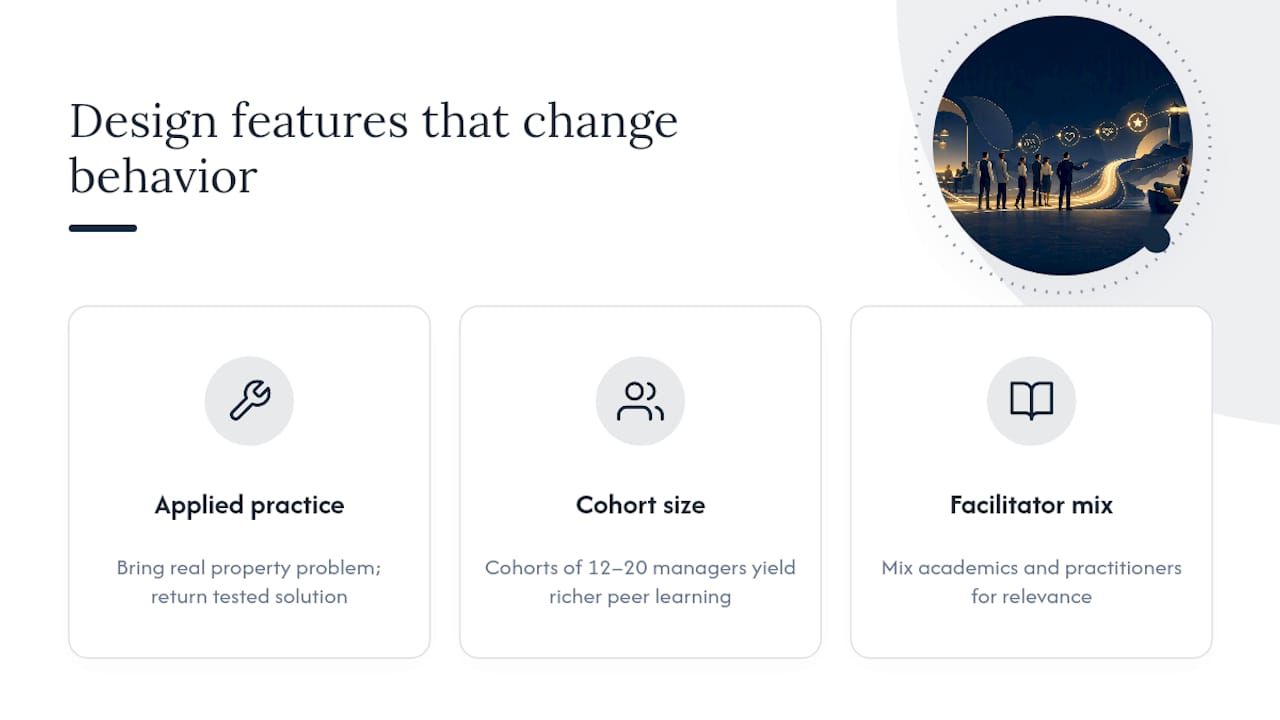
Applied workplace projects require you to bring a real problem from your property into the program and return with a tested solution. Cornell's Hospitality Management certificate, for example, frames coursework around the guest cycle and emphasizes practical projects that translate quickly into on-the-job performance. Programs that assign only reading and quizzes rarely produce the same behavior change.

Cohort size and peer discussion matter more than most program pages admit. A cohort of 12–20 working managers produces richer peer learning than a self-paced course with 500 concurrent enrollees. Ask the admissions team for the average cohort size before you enroll.

Faculty mix is the most overlooked quality signal. Academic instructors bring research depth and credentialing credibility. Practitioner facilitators bring current operational context. The best programs use both. A program staffed entirely by academics may lack operational relevance; one staffed entirely by practitioners may lack the rigor to support a university-issued credential.
Pro Tip: Before enrolling, ask: "Can you show me an example of a participant's applied project and the feedback they received?" A program that cannot answer that question probably does not have a meaningful applied component.
Red flags: no faculty bios on the program page, no description of assessments or projects, vague claims about "real-world application" with no specifics, and no alumni outcomes listed.
How to evaluate and choose the right program
Use this checklist in order. The first three criteria eliminate most weak programs before you spend time on pricing.
- Career outcome alignment: Does the program explicitly state what role or competency level it prepares you for? If the answer is "anyone in hospitality," that is a red flag.
- Applied practice: Is there a workplace project, simulation, or field assignment? If the only assessment is a quiz, the program will not change your behavior on the floor.
- Credential value: Does it award a university certificate, CEUs, or SHRM/HRCI credits? Match the credential type to your career goal.
- Instructor mix: Are faculty bios listed? Do they include both academic and practitioner credentials?
- Cohort size: Ask directly. Under 25 participants per cohort is a reasonable benchmark for meaningful peer interaction.
- Schedule fit: Can you complete it without taking leave? A program you cannot finish is a sunk cost.
- Employer sponsorship options: Does the provider offer employer invoicing or group pricing? Senior leadership in hospitality increasingly supports training budgets when the ROI case is clear.
Questions to ask admissions teams:
- What percentage of participants complete the program?
- Can I speak with a recent graduate in a similar role?
- How are applied projects assessed, and by whom?
- What credential does the program award, and is it recognized by AHLEI or a university accreditor?
Answers that indicate quality: specific completion rates, willingness to connect you with alumni, detailed project rubrics, named accreditation body.
Answers that indicate marketing spin: "Our graduates go on to great careers," no specific data, vague references to "industry recognition."
How Wits' End Solutions delivers leadership development
Wits' End Solutions designs and delivers hospitality training programs for hotel and restaurant teams across the United States. The engagement model is built around your operation's actual gaps, not a generic curriculum.
A typical engagement moves through four stages:
- Scoping: We assess your current team structure, performance data, and leadership gaps before writing a single module.
- Curriculum design: Content is built around your brand standards, your PMS and POS environment, and the specific competencies your managers need at their career stage.
- Delivery and coaching: Sessions combine workshop instruction with applied assignments tied to live operational metrics. Managers leave with toolkits they can use the next shift.
- Performance tracking: We integrate with your analytics to measure the impact of training on labor cost, guest scores, and team retention.
| Engagement model | Best fit | Typical output |
|---|---|---|
| Workshop series (on-property) | Single property, team of 5–20 | Applied toolkits, KPI baseline, action plan |
| Retainer coaching | Multi-property or growing group | Ongoing manager development, monthly performance reviews |
| Task force + training | Turnaround or new opening | Rapid skill-building alongside operational stabilization |
Wits' End Solutions does not sell a shelf curriculum. Every program is built by practitioners who have run properties, managed P&Ls, and coached teams through openings and turnarounds. That operational background is what separates a training engagement from a workshop that sounds good and changes nothing.
What most training programs get wrong, and what actually works
The most common mistake I see emerging hospitality managers make is enrolling in a program that matches their ambition rather than their current career stage. A supervisor who signs up for a director-level executive program before mastering one-on-ones and shift handoffs will absorb the theory and struggle to apply it. The UNLV research on competency prioritization backs this up: getting the focus wrong at the wrong stage is one of the most reliable ways to stall a career.
The second mistake is treating a certificate as the outcome rather than the tool. A credential opens a door. What you do with the applied project, the peer network, and the feedback from a practitioner facilitator is what actually changes your performance. EHL's research on self-leadership is clear that self-awareness is the foundation everything else is built on. Start there, regardless of which program you choose.
Two things you can do right now, before you enroll anywhere: write down the one leadership behavior your current manager or owner has flagged as a gap, and find one program whose applied project directly addresses it. That single alignment check will tell you more than any program ranking.
Wits' End Solutions can build your team's leadership program
Wits' End Solutions works with hotel and restaurant operators across the United States to design leadership programs that fit your property, your team, and your performance targets. Rather than enrolling your managers in a generic course and hoping it sticks, we scope the gaps first, build the curriculum around your actual operation, and measure the results against your KPIs.
A typical engagement starts with a scoping conversation, moves into a tailored workshop series with applied assignments, and closes with a performance review tied to your labor and guest metrics. Operators who want ongoing development can move into a retainer coaching model. If you are in a turnaround or opening, our task force services can combine rapid operational stabilization with structured leadership development for your team.
Talk to Wits' End Solutions about building a leadership program for your property.
Sources
- Hospitality Leadership - eCornell - Cornell University
- Hospitality Leadership Development Program – Emerging Leaders Program 2-Day – Hospitality Executive Education
- 8 Essential Leadership Skills All Hotel Managers Should Have – Hcareers
- EHL_HLS_Executive_Report.pdf
- UNLV hotel faculty article on competency prioritization