
TL;DR:
- An effective hotel F&B marketing workflow integrates operational data, first-party guest information, and automation tools to increase revenue and margins. It requires real-time cost tracking, standardized recipes, and segmentation campaigns, supported by AI and automated systems. Fragmentation between departments and manual processes are common challenges, but automation and cross-functional collaboration improve efficiency and profitability.
A hotel F&B marketing workflow is a coordinated system that aligns marketing execution, cost control procedures, and operational data to increase food and beverage revenue and guest satisfaction. F&B generates 20–40% of total hotel revenue but operates on net profit margins of just 5–15%, which means sloppy workflows cost real money fast. The professionals who win in this space treat marketing and operations as one connected system, not two separate departments. This guide walks you through the components, execution steps, and common failure points of a workflow that actually holds up under daily service pressure.
What does an efficient hotel F&B marketing workflow require?
The industry term for this discipline is integrated F&B operations management, and the hotel f&b marketing workflow is the execution layer that makes it run. Before you can market effectively, your operational data must be clean, connected, and current. That means your property management system (PMS), point-of-sale system (POS), customer relationship management platform (CRM), and inventory management software all need to talk to each other.

Here is how the core tools map to their functions:
| Tool | Primary function |
|---|---|
| PMS (e.g., Opera, Mews) | Guest profile data, stay history, spend patterns |
| POS (e.g., Micros, Lightspeed) | Real-time sales, item-level cost tracking |
| CRM (e.g., Salesforce, HubSpot) | Guest segmentation, campaign management |
| Recipe costing software (e.g., Wisk, MarketMan) | Standard recipe enforcement, theoretical cost calculation |
| Marketing automation (e.g., Klaviyo, Revinate) | Triggered campaigns, journey-stage messaging |
| Inventory management | FIFO tracking, purchase order automation |
First-party data integration into marketing automation delivers 25–30% higher conversion rates compared to relying on third-party data. That gap exists because first-party data reflects actual guest behavior at your property, not modeled behavior from an external audience pool. The team roles that matter most here are the F&B director, revenue manager, and marketing manager working from a shared data source, not separate spreadsheets.
Standard recipes and FIFO inventory are not optional components. They are the foundation that makes every downstream marketing decision defensible. Without them, your cost data is unreliable, and unreliable cost data produces campaigns built on fiction.
How to build a step-by-step hotel F&B marketing workflow
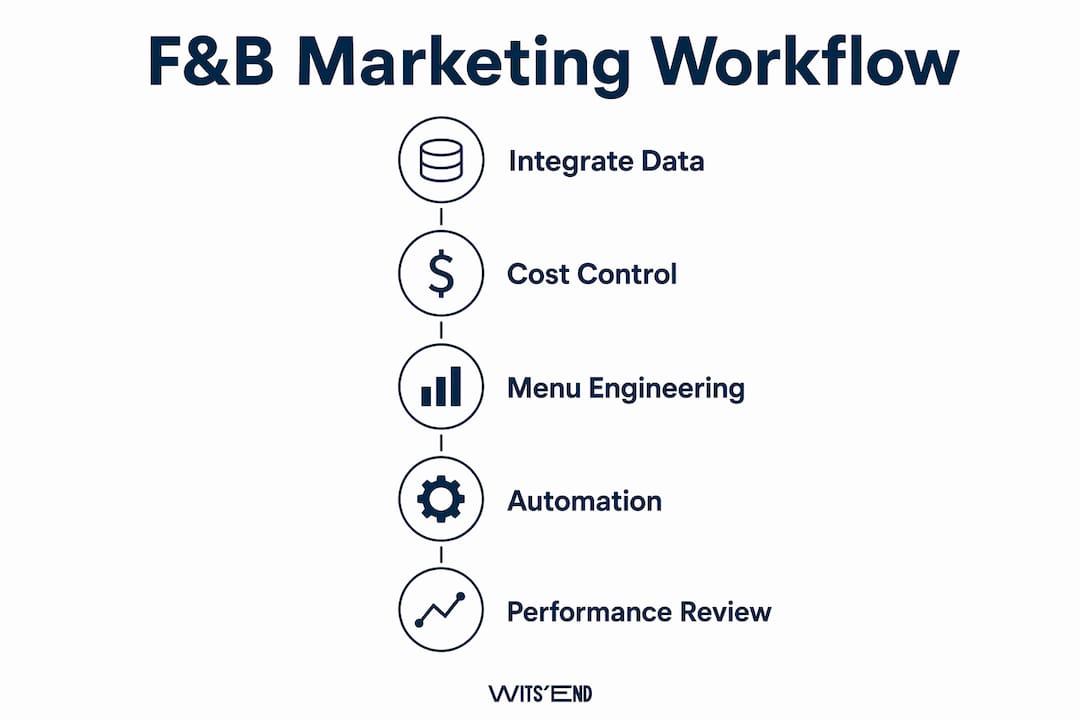
This is where most operators have the right intentions but the wrong sequence. Follow these steps in order.
-
Forecast demand and plan purchasing. Pull PMS occupancy data weekly. Cross-reference it with historical F&B spend by segment. Use that forecast to build purchase orders, not gut instinct.
-
Receive and log deliveries using FIFO. Every delivery gets logged against the purchase order on receipt. Older stock moves to the front. This step prevents spoilage from becoming invisible waste.
-
Enforce standard recipes and portion control during service. Every dish has a recipe card with gram-level portions. Standardized recipes and FIFO reduce food costs by 5–15%. A 1% cost reduction at a 100-room hotel can add $50,000–$150,000 to annual profit. That is not a rounding error.
-
Record wastage and calculate daily AvsT variance. AvsT stands for Actual versus Theoretical cost. Daily AvsT monitoring is the difference between catching a portioning problem on Tuesday and discovering it at month-end when the damage is done. Static reporting hides punctual issues that daily tracking catches immediately.
-
Automate data entry with invoice parsing and POS integration. Manual data entry is the single biggest time drain in F&B operations. Automated invoice parsing saves approximately 15 hours per property per week at 99.9% accuracy. That is 60 hours a month your team gets back for revenue-generating work.
-
Segment your audience and build journey-mapped campaigns. Use your CRM to divide guests into segments: leisure travelers, corporate accounts, local diners, event bookers. Map each segment to a channel. Email works best for retention and repeat visits. Metasearch and paid social drive new acquisition. Interactive inquiry workflows that map the full guest journey from first contact to post-event follow-up maintain personalization without requiring manual effort at every touchpoint.
-
Monitor KPIs daily and adjust pricing or promotions with AI support. Set a 34% combined food and beverage cost threshold as your baseline. Build daily alerts that fire when any menu category exceeds that target. Use AI decision-support tools to surface which items are dragging margin before your weekly menu engineering meeting.
Pro Tip: Track food cost as a rolling metric by individual menu item, not as a blended percentage across the whole menu. Blended percentages hide underperforming dishes. Item-level tracking tells you exactly which plate is eroding your margin.
What challenges most often break hotel F&B marketing workflows?
System fragmentation is the primary failure mode. Disconnected PMS, POS, and CRM systems create friction between marketing, revenue management, and operations. When those teams are working from different data sets, campaigns get built on assumptions and cost controls get enforced inconsistently.
Here are the most common breakdowns and how to address them:
- Siloed departments. Marketing runs promotions without checking with the kitchen on food cost. Operations tracks waste without sharing it with the revenue manager. Fix this with a weekly cross-functional meeting anchored to shared dashboards.
- Static monthly reporting. Monthly P&L reviews tell you what happened, not what is happening. Shift to daily cost tracking with automated alerts. The AvsT framework gives you real-time corrective ability.
- Manual data entry bottlenecks. When your team spends hours reconciling invoices by hand, menu engineering gets pushed to quarterly instead of weekly. Automated inventory-to-ledger systems fix this directly.
- Ignoring guest segmentation. Sending the same promotion to a corporate account and a leisure traveler is a waste of both budget and goodwill. Segment before you send.
- Over-relying on blended cost percentages. A 30% blended food cost can mask a 50% cost on your highest-volume item. Item-level tracking is non-negotiable.
"The biggest missed opportunities in hotel workflows arise from disconnected systems causing friction between marketing, revenue, and operations." — Revfine AI Agent Design
For multi-location operators, the challenge compounds. AI agents configured to standardize brand voice and workflows while respecting location-specific variations are the most practical solution at scale. Without that layer, consistency across properties becomes a manual management problem that grows with every new location you add.
How can first-party data and AI improve your F&B marketing results?
First-party data is the most underused asset in hotel F&B marketing. You already collect it through your PMS, POS, and loyalty program. The question is whether you are activating it. Hotels that adopt segmented, journey-aligned marketing strategies achieve measurably better ROI and guest retention than those running undifferentiated campaigns.
Here is how to put first-party data to work across your marketing channels:
- Email for retention. Email marketing returns an average of 36–42 dollars per dollar spent. Use it for post-stay F&B offers, birthday promotions, and loyalty rewards tied to dining spend.
- Metasearch for acquisition. Metasearch drives 15–25% growth in direct bookings at 40–60% lower acquisition cost than OTAs. Pair it with F&B package offers to increase average booking value.
- Multi-touch attribution for budget allocation. Multi-touch attribution models reduce marketing costs by 10–15% compared to last-click methods. That savings goes back into campaigns that actually convert.
- AI decision support for real-time adjustments. AI agents that unify marketing, revenue management, and operations data allow your team to act on insights the same day they surface, not at the next quarterly review.
Pro Tip: Build an automation flow that triggers a personalized F&B offer within 24 hours of a guest booking. Guests who receive a pre-arrival dining offer convert at significantly higher rates than those who receive the same offer on arrival.
For a deeper look at hospitality marketing strategies that connect digital channels to F&B revenue, the principles of guest journey mapping apply directly to how you sequence your campaigns. The goal is not more messages. It is the right message at the right stage of the guest relationship.
Automating menu engineering and cost tracking frees your team to focus on F&B profit optimization rather than manual reconciliation. That shift in how your team spends its time is where the real competitive advantage lives.
Key takeaways
An integrated hotel F&B marketing workflow connects operational cost control, first-party guest data, and marketing automation into one system that drives both margin and revenue simultaneously.
| Point | Details |
|---|---|
| Integration is non-negotiable | Connect PMS, POS, CRM, and recipe costing tools before building any campaign. |
| Daily cost tracking beats monthly reporting | AvsT monitoring catches margin problems in real time, not at month-end. |
| First-party data drives conversion | Segmented, journey-mapped campaigns outperform generic promotions by 25–30%. |
| Automation reclaims staff time | Invoice parsing and POS integration save 15+ hours per property per week. |
| Item-level cost tracking reveals true margin | Blended food cost percentages hide underperforming dishes that erode profit. |
What I have learned from operators who get this right
The operators I have seen build genuinely effective F&B workflows share one habit: they treat the kitchen and the marketing desk as one revenue center, not two separate cost centers. That sounds obvious until you watch how most hotels actually run. Marketing sets a promotion without checking theoretical food cost. The kitchen runs a special without telling revenue management. The result is a busy weekend that somehow loses money.
The shift I advocate for is weekly menu engineering backed by automated data. Most operators settle for quarterly reviews because manual data consolidation is too slow. That is a solvable problem, not an industry constraint. When you automate the consolidation, your team can actually do the analysis every week, and weekly adjustments compound into meaningful margin improvement over a quarter.
The other thing I push back on is the idea that AI is a future investment. AI decision-support tools are available now, they are not expensive relative to the labor they replace, and the operators who are not using them are already behind. The question is not whether to adopt them. It is whether you configure them well enough to trust the output.
Multi-location operators face a specific version of this challenge. Standardizing workflows across properties without flattening the personality of each location requires deliberate configuration. The technology can handle it. The harder work is getting your teams aligned on what consistency actually means versus what local flexibility looks like.
— Chris
How Wits' End Solutions supports your F&B workflow
Wits' End Solutions works with hotel and restaurant operators across the United States to build the exact kind of integrated workflow this article describes. Our team covers brand development, deep analytics, and hands-on training programs that shift your team from manual reconciliation to revenue-focused work. We have run these operations ourselves, which means our recommendations come from experience, not theory. Whether you need an outside advisor, an embedded operating partner, or a task force to stabilize a specific property, Wits' End Solutions builds the model around what your business actually needs. Reach out for a consultation and we will show you exactly where your current workflow is leaving money on the table.
FAQ
What is a hotel F&B marketing workflow?
A hotel F&B marketing workflow is an integrated system that connects marketing campaigns, cost control procedures, and operational data to increase food and beverage revenue. It links tools like PMS, POS, CRM, and recipe costing software into a single coordinated process.
How does first-party data improve hotel F&B marketing?
First-party data from your PMS and POS allows you to segment guests by behavior and map campaigns to specific journey stages. This approach delivers 25–30% higher conversion rates compared to third-party data reliance.
What is AvsT and why does it matter for F&B cost control?
AvsT stands for Actual versus Theoretical cost. It compares what your food should cost based on standard recipes against what it actually cost, giving you a daily signal when portioning or waste is eroding margin.
How often should hotels conduct menu engineering?
Weekly menu engineering is the standard best practice, but most operators default to quarterly because manual data consolidation is too slow. Automating inventory-to-ledger reconciliation makes weekly reviews practical and sustainable.
What is the standard food and beverage cost threshold for hotels?
A 34% combined food and beverage cost is the standard threshold during flat-margin years. Daily alerts that fire when any menu category exceeds this target allow teams to take corrective action before the issue compounds.