
TL;DR:
- Food and beverage operations offer high, recurring revenue that appeals to investors because of predictable cash flow and global growth potential. Strategic management, strong branding, and scalable systems are essential for maximizing margins and protecting investments, especially within franchise models. Integrating F&B with hospitality portfolios enhances overall value through increased revenue, guest loyalty, and operational efficiencies.
Food and beverage operations are defined by their ability to generate recurring, high-frequency revenue that few other business categories can match. For hospitality investors, the question of why invest in F&B operations comes down to three fundamentals: predictable cash flow, brand-driven competitive advantage, and a global market that keeps growing. Global foodservice revenue is projected to exceed $4 trillion in 2026, driven by urbanization, middle-class expansion, and delivery platforms. That scale creates real investment opportunity for owners and operators who understand how to build and run these businesses well.
Why invest in f&b operations: the financial case
The financial argument for F&B investment is grounded in margin structure, visit frequency, and operational leverage. These are not speculative returns. They are the product of disciplined management applied to a business model that consumers use constantly.
Margin targets that matter:
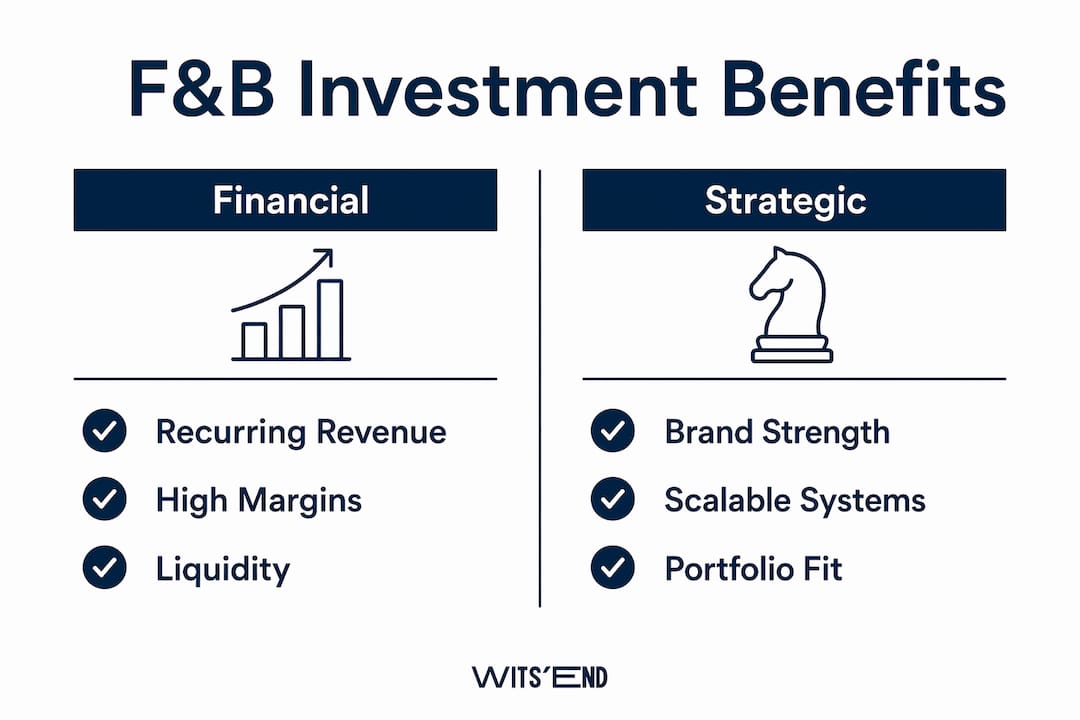
- Well-operated F&B businesses target EBITDA margins of 15–24%. That range signals operational discipline and long-term scalability, not just top-line revenue.
- Restaurant franchises have historically generated 12–15% annual cash-on-cash returns. That performance is what draws institutional capital into the sector year after year.
- Recurring revenue from frequent visits makes F&B cash flows more predictable than project-based businesses. Private equity firms specifically favor this model because the revenue base does not reset with each transaction.
Pro Tip: Track your EBITDA margin monthly, not quarterly. Margin erosion in F&B happens fast, and catching it early is the difference between a correction and a crisis.
Beyond the headline numbers, operational levers like menu pricing, labor scheduling, and supply chain management give experienced investors direct tools to improve profitability. This is not passive investing. The operators who hit the top of that 15–24% EBITDA range are the ones pulling those levers deliberately, using data to make decisions rather than instinct alone.

The importance of F&B investment also shows up in portfolio context. Unlike real estate, which ties up capital in illiquid assets, a well-run F&B operation generates cash monthly. That liquidity profile makes it a useful complement to longer-horizon hospitality investments.
How do brand strength and economic moats protect f&b investments?
Brand is not a marketing concept in F&B investing. It is a financial asset. Strong brands and proprietary systems create economic moats that protect investors from competition and market volatility. Warren Buffett's long-term positions in companies like Coca-Cola and See's Candies are the clearest proof that brand loyalty compounds over time in ways that balance sheets do not fully capture.
"Brand loyalty and operational culture are intangible assets difficult to replicate." The investors who recognize this early build businesses that competitors cannot simply outspend.
The economic moats in F&B come from four specific sources:
- Proprietary recipes and sourcing relationships that competitors cannot easily copy
- Operational culture built through years of training, hiring, and management discipline
- Distribution and location advantages that create physical barriers to entry
- Guest loyalty programs and data that give established brands a customer acquisition cost advantage
The failure cases are instructive. Brands that scaled rapidly without protecting quality lost their moat before they realized it was gone. Several fast-casual concepts in the 2010s expanded to hundreds of locations, then watched same-store sales collapse because the guest experience did not travel with the unit count. Growth alone is insufficient. Investors who prioritize quality and durability over speed consistently outperform those chasing unit growth.
Building a defensible brand requires intentional work from the start. The hospitality brand-building process covers how to construct that foundation before you scale, not after problems appear.
Pro Tip: Before you invest in a second location, audit whether your first location's guest experience is fully documented and repeatable. If it lives in the founder's head, it is not scalable.
What role do franchises and scalable systems play in f&b investment success?
Franchise models reduce investment risk by transferring proven operational knowledge to the investor from day one. Franchise models provide established playbooks, training programs, and marketing infrastructure that independent operators spend years building on their own. That head start has real financial value.
| Investment Model | Key Advantage | Primary Risk |
|---|---|---|
| Franchise (single unit) | Proven brand and systems | Limited operational control |
| Franchise (multi-unit) | Economies of scale, lower per-unit cost | Capital intensity, management depth |
| Independent concept | Full creative and operational control | Brand building from zero |
| Institutional F&B group | Professional management, data infrastructure | Complexity, overhead cost |
Multi-unit franchise operators benefit from economies of scale across purchasing, staffing, and marketing. A group operating ten locations can negotiate supplier contracts that a single-unit operator cannot access. That cost structure difference shows up directly in margin.
Technology platforms have become a core part of scalable F&B operations. Point-of-sale systems like Toast and Square for Restaurants, inventory management tools, and labor scheduling software give operators the data infrastructure to manage multiple locations without proportional headcount increases. Institutional investors specifically look for this infrastructure because it signals that the business can grow without losing control of its cost structure.
Pro Tip: When evaluating a franchise opportunity, request the Item 19 Financial Performance Representation from the Franchise Disclosure Document. It is the only place where franchisors are required to share actual unit economics.
The value of F&B operations in a multi-unit context also comes from the ability to test and iterate. A group with five locations can run a menu pricing test across two units, measure the margin impact, and roll out the winner across the portfolio in 30 days. An independent operator with one location takes the same risk with no control group.
How does f&b investment fit within broader hospitality strategies?
F&B operations do not exist in isolation from the rest of a hospitality portfolio. They complement hotel real estate, drive ancillary revenue, and create guest experiences that increase overall asset value. A hotel with a strong restaurant concept commands higher average daily rates and better guest satisfaction scores than a comparable property with a generic food offering.
Sale-leaseback strategies allow investors to recoup capital from real estate while retaining operational control of the F&B business. This approach separates the real estate return from the operating return, letting investors optimize each independently. Sophisticated hospitality investors use this structure to free up capital for additional acquisitions while maintaining the brand and revenue stream.
The synergies between F&B and lodging assets are concrete:
- Revenue capture: Hotel guests who dine on property spend more per stay and generate higher total revenue per available room.
- Brand reinforcement: A well-executed restaurant strengthens the hotel's overall brand identity and drives direct booking behavior.
- Labor efficiency: Shared back-of-house infrastructure between hotel food service and restaurant operations reduces per-unit labor costs.
- Data integration: Combined guest data from lodging and dining creates marketing and loyalty program advantages that neither asset generates alone.
F&B strategy that is built into the hotel investment thesis from the start outperforms F&B that is treated as an afterthought. The difference shows up in both RevPAR and restaurant-level EBITDA. Investors who treat these as separate decisions leave money on the table.
Investing in team training is another lever that integrated hospitality investors often undervalue. A trained service team drives repeat visits, higher check averages, and better online reviews. All three of those outcomes have measurable financial impact on both the F&B operation and the broader property.
Key takeaways
Investing in F&B operations delivers the strongest returns when operational discipline, brand strength, and scalable systems work together from the start.
| Point | Details |
|---|---|
| Margin targets signal health | Well-operated F&B businesses target EBITDA margins of 15–24%; track this monthly, not quarterly. |
| Brand is a financial asset | Economic moats from brand loyalty and proprietary systems protect returns better than unit count alone. |
| Franchise models reduce risk | Proven playbooks and training infrastructure lower the cost of scaling compared to building from scratch. |
| F&B and hospitality assets compound | Integrated F&B and lodging strategies generate higher RevPAR, better guest data, and lower per-unit labor costs. |
| Operational levers drive margin | Menu pricing, labor scheduling, and supply chain management are the tools that move EBITDA within your control. |
What i've learned about f&b investment after years in the field
The investors I've seen succeed in F&B are not the ones who moved fastest. They are the ones who stayed focused on the unit economics of each location before adding the next one. The temptation to grow is real, especially when a concept gets early traction. But I've watched operators open their fifth location before their first one was actually profitable on a fully loaded basis. That math does not improve with scale. It gets worse.
The other pattern I've noticed is that investors underestimate how much of the return comes from people, not systems. Technology helps. Data helps. But the manager who runs a tight pre-shift, coaches the team through a difficult Saturday night, and reads the P&L every week is the one who actually delivers the margin. You can have the best POS system in the industry and still lose money if the culture is not right.
My honest advice: before you commit capital to an F&B investment, spend time in the operation. Not a site visit. Actual time. Eat there multiple times, at different dayparts, on different days of the week. Talk to the staff. Watch how the manager handles a problem. The financial model will tell you what the business could be. The operation will tell you what it actually is.
Deep analytics can surface the gaps between those two things faster than any manual review. But you still have to be willing to act on what the data shows.
— Chris
How wits' end solutions helps investors build profitable f&b operations
Wits' End Solutions works with hospitality investors and operators at every stage of the F&B lifecycle, from initial concept through daily operations. Our brand development services help investors build the kind of brand equity that creates real competitive protection, not just a logo and a color palette. Our analytics platform, powered by the Ingest partner system, gives operators the P&L visibility and operational reporting they need to manage margin at the unit level. For investors who need boots on the ground, our task force programs place experienced hospitality leaders directly into your operation to stabilize performance and build management depth. If you are evaluating an F&B investment or trying to improve the one you already have, we are ready to work alongside you.
FAQ
What financial returns can f&b investments realistically generate?
Well-operated F&B businesses target EBITDA margins of 15–24%, and restaurant franchises have historically generated 12–15% annual cash-on-cash returns. Returns depend heavily on operational discipline and the quality of management in place.
Why do private equity firms invest in restaurants despite thin margins?
Private equity firms favor restaurants because of predictable, recurring revenue from high visit frequency and the ability to improve margins through operational levers like pricing, labor, and supply chain. Scalable systems also make restaurant groups attractive acquisition targets.
How does brand strength protect an f&b investment?
Strong brands create economic moats through guest loyalty, proprietary systems, and operational culture that competitors cannot easily replicate. These intangible assets translate directly into pricing power and lower customer acquisition costs over time.
What is the advantage of a franchise model for new f&b investors?
Franchise models provide proven operational playbooks, training programs, and marketing support that reduce the time and capital required to reach profitability. The standardized processes also make multi-unit scaling more predictable than building an independent concept from scratch.
How does f&b investment connect to broader hospitality real estate strategies?
Sale-leaseback structures allow investors to separate the real estate return from the operating return, freeing capital for additional acquisitions. Integrated F&B and lodging assets also generate higher revenue per available room and stronger guest loyalty data than either asset produces independently.