
TL;DR:
- The restaurant lifecycle consists of five stages: startup, survival, growth, scale, and maturity. Each phase demands different operational systems, financial tools, and customer strategies to ensure profitability and longevity.
The restaurant lifecycle is a structured progression through five defined stages: Startup, Survival, Growth, Scale, and Maturity. Each stage carries distinct operational demands, financial pressures, and management priorities. Understanding where your restaurant sits in this progression is the single most reliable way to make decisions that match your actual business reality. Only 17–17.5% of restaurants close in their first year, a figure far lower than the myth suggests, yet 42% of operators remain unprofitable at any given time. The gap between those two facts lives inside the lifecycle.
What are the five stages of the restaurant lifecycle?
The restaurant lifecycle, sometimes called the restaurant business stages or the business life cycle applied to foodservice, maps how an operation evolves from concept to maturity. Each stage has a defined timeframe, core activities, and financial profile.
Stage 1: Startup and pre-opening
The pre-opening phase lasts 8–14 months on average, covering lease negotiation, design, permitting, construction, equipment procurement, staff training, and a soft opening. That timeline breaks down roughly as follows: 4–10 weeks for lease negotiation, 6–12 weeks for design, 4–16 weeks for permitting, 12–24 weeks for build-out, 4–8 weeks for equipment installation, 4–8 weeks for training, and 1–3 weeks for soft opening. Every week of delay burns capital before a single cover is served.
A restaurant launch checklist is not optional at this stage. It is the only reliable way to track parallel workstreams without losing ground on any one of them.

Stage 2: Survival and stabilization (months 6–18)
The survival stage is where most financial stress concentrates. Revenue is unpredictable, the team is still learning, and fixed costs do not flex. The primary goal is reaching break-even, which typically occurs between months 12 and 24. Prime cost control, meaning the combined total of food cost and labor cost, becomes the daily discipline.
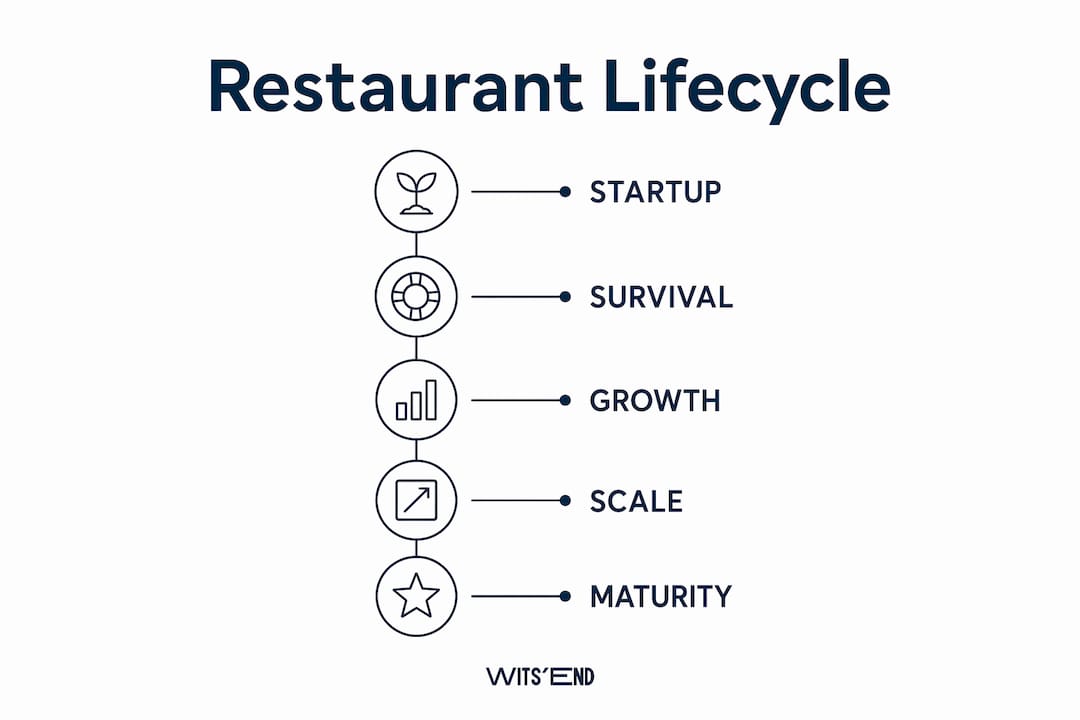
Stage 3: Growth and expansion (years 2–5)
A restaurant in the growth stage has proven its concept and is building a loyal customer base. Margins begin to improve as purchasing volume increases and the team operates with less supervision. Owners shift attention from daily firefighting to menu profitability, marketing, and repeat-visit rates.
Stage 4: Scale and structure (years 4–10)
Scaling requires formal systems. Informal management works for one location. It fails predictably as the operation grows. System failures occur at specific location thresholds: checklist failures at 3–7 locations, audit trail failures at 8–20, and reporting and compliance failures at 20–50 or more. Building infrastructure before these breakpoints is what separates groups that scale from groups that stall.
Stage 5: Maturity and exit
A mature restaurant has stable revenue, documented systems, and a clear brand identity. The owner's focus shifts to protecting margin, maintaining relevance, and planning an exit if appropriate. Exit options include outright sale, franchise licensing, or equity recapitalization. EBITDA multiples at sale vary by concept type, market, and operational quality.
| Stage | Timeframe | Primary Focus |
|---|---|---|
| Startup / Pre-opening | 0–14 months | Concept, build-out, permitting, soft open |
| Survival / Stabilization | Months 6–18 | Break-even, prime cost control, cash flow |
| Growth / Expansion | Years 2–5 | Customer base, margin improvement, marketing |
| Scale / Structure | Years 4–10 | Systems, multi-unit infrastructure, compliance |
| Maturity / Exit | Year 10 and beyond | Value protection, brand relevance, exit planning |
How do financial strategies change across the restaurant lifecycle?
Capital needs shift at every stage, and using the wrong financing tool at the wrong time creates compounding problems.
Before opening, operators must budget working capital to cover 6 months of fixed costs post-opening. That reserve exists to absorb the revenue ramp-up period before break-even is reached. Owners who open without it are betting on a best-case revenue curve from day one.
During the survival stage, financing is defensive. The goal is staying liquid, not growing. Short-term tools like merchant cash advances or small business lines of credit cover gaps. The moment a restaurant crosses break-even and demonstrates consistent revenue, the financing conversation changes entirely.
- Startup stage: Personal savings, SBA loans, and investor equity fund the build-out and pre-opening reserve.
- Survival stage: Lines of credit and short-term working capital loans manage cash flow gaps.
- Growth stage: Equipment financing, expanded credit lines, and reinvested profit fund menu development and marketing.
- Scale stage: Equity partners, franchise fees, or institutional debt fund multi-unit expansion.
- Maturity stage: Refinancing existing debt and building EBITDA documentation prepare the business for a sale or recapitalization.
Data-driven restaurants achieve 23% higher survival rates by using analytics to manage labor, menu profitability, and customer retention. That number reflects a real operational discipline, not a technology purchase. Knowing your numbers at every stage is what makes the right financing decision obvious.
Pro Tip: Track your prime cost weekly, not monthly. A monthly P&L tells you what happened. A weekly prime cost report tells you what is happening, while you still have time to act.
What operational challenges shift through the restaurant lifecycle?
Operations look completely different at each phase of restaurant development. The skills that get a restaurant open are not the same skills that scale it.
The pre-opening phase is where owners most commonly underestimate timelines by 30% or more, causing capital exhaustion before the first service. Compressing equipment installation cycles is a specific risk. Opening with uncommissioned kitchen equipment means your team trains on unreliable tools and your soft opening produces inconsistent food.
During the survival stage, the two operational levers with the most impact are labor scheduling and menu-market fit. Data-driven managers reduce labor costs from 42.9% to 34.2% through disciplined scheduling tied to actual cover counts. Menu-market fit, meaning the alignment between what you sell and what your specific market wants to buy, is a leading cause of early failure when it is wrong.
"Moving from survival owner to data-driven manager is the most important transition a restaurant operator makes. The operators who make it thrive. The ones who don't keep grinding until they can't."
As a restaurant scales beyond three locations, formal documentation becomes non-negotiable. Standard operating procedures, training manuals, and audit trails replace institutional memory. System failures at the 3–7 location threshold are almost always checklist failures, meaning no one wrote down how things are supposed to work.
- Pre-opening: Build a commissioning schedule for all equipment. Never open with an untested kitchen.
- Survival: Schedule labor to the quarter-hour based on forecasted covers, not habit.
- Growth: Document every repeatable process before you need a second manager to run it.
- Scale: Invest in daily operations systems that generate audit trails automatically.
- Maturity: Treat equipment lifecycle management as a planned discipline. Tracking asset records and scheduling preventive maintenance eliminates the emergency repair costs that erode mature-stage margins.
Pro Tip: Build your operations manual during the growth stage, not the scale stage. By the time you need it at scale, you will not have time to write it.
How does customer retention connect to the restaurant lifecycle?
Customer behavior is not static, and neither is your relationship with your guests. Understanding restaurant growth means understanding how your guest base evolves alongside your business.
Regular customers account for up to 80% of profits in a well-run restaurant. That figure reframes the entire marketing conversation. Acquiring new guests matters, but retaining the ones you already have is the more profitable activity at every stage past survival.
The guest lifecycle is a dynamic system. Integrated POS and WiFi data enable continuous recalculation of guest states, classifying guests as new, returning, at-risk, or lapsed in real time. Automated campaigns triggered by those classifications, a birthday offer, a win-back message after 60 days of absence, a loyalty reward at the fifth visit, produce measurable revenue attribution without manual effort.
- Survival stage: Focus on converting first-time guests into second-visit guests. The second visit is where loyalty begins.
- Growth stage: Build an email list and use it. A guest who opts in is signaling intent to return.
- Scale stage: Invest in a CRM that integrates with your POS. Manual guest tracking does not survive multi-unit growth.
- Maturity stage: Use restaurant analytics to identify your highest-value guest segments and protect them with personalized engagement.
Menu alignment with local market preferences drives repeat visits more reliably than discounting. A menu built around what your specific guests want to eat, at a price they find fair, outperforms a broader menu that tries to appeal to everyone and satisfies no one.
Key takeaways
The restaurant lifecycle is a five-stage framework that requires distinct financial tools, operational systems, and customer strategies at each phase to sustain profitability and growth.
| Point | Details |
|---|---|
| Pre-opening takes longer than expected | Budget for 8–14 months and hold 6 months of working capital before opening day. |
| Prime cost is the survival-stage metric | Track food and labor costs weekly to catch problems before they compound. |
| Systems must precede scale | Build documentation and audit trails before the 3–7 location threshold, not after. |
| Regular guests drive the majority of profit | Up to 80% of profits come from repeat customers; retention outperforms acquisition at every mature stage. |
| Data-driven management raises survival odds | Restaurants using analytics achieve 23% higher survival rates than those operating on instinct alone. |
What I've learned watching restaurants move through each stage
The part of the lifecycle that surprises owners most is not the hard part they expected. It is the transition between stages. Most operators know the pre-opening is brutal. They prepare for it mentally and financially, at least somewhat. What catches them off guard is the moment the restaurant stabilizes and they have to stop being a survival operator and start being a growth manager. Those are genuinely different jobs.
I have watched talented operators stall at the survival-to-growth transition because they kept managing by feel when the business was ready for data. They knew their regulars by name, knew their kitchen by instinct, and could not read a weekly prime cost report without glazing over. That is not a character flaw. It is a skill gap, and it is fixable. But it has to be recognized first.
The other transition that gets underestimated is the move from one location to three. One location is a restaurant. Three locations is a company. The moment you cannot be physically present in every location every shift, your systems either carry the operation or the operation degrades. I have seen groups with strong single-unit concepts fall apart at location two because no one wrote anything down. The concept was in the founder's head, and it could not be transferred.
My honest advice: treat every stage transition as a deliberate decision, not a natural event. Decide when you are moving from survival to growth. Decide when you are ready to scale. Build the infrastructure before you need it, not after you feel the pain of not having it.
— Chris
How Wits' End Solutions supports owners at every lifecycle stage
Wits' End Solutions works with restaurant owners from the first concept sketch through multi-unit operations. For owners in the pre-opening phase, the team covers brand design and development, interior design support, menu creation, and construction guidance. For operators in the growth and scale stages, Wits' End Solutions provides deep analytics and advising that translate P&L data into decisions, not just reports. Task force deployments place experienced operators on property when a location needs hands-on stabilization. Training programs build the team competency that systems alone cannot create. Every engagement is built around what the business actually needs at its current stage.
FAQ
What does the restaurant lifecycle mean?
The restaurant lifecycle is the five-stage progression a restaurant moves through from pre-opening to maturity, each stage defined by distinct financial needs, operational priorities, and management demands.
How long does each stage of the restaurant lifecycle last?
The pre-opening stage lasts 8–14 months, survival runs from months 6–18, growth spans years 2–5, scale covers years 4–10, and maturity begins around year 10 and continues until exit or closure.
What is the most common reason restaurants fail in early stages?
Poor menu-market fit and undercapitalization are the leading causes of early failure. Owners who open without 6 months of working capital reserves and without validating their menu against local demand face the highest risk.
How do I know when my restaurant is ready to scale?
A restaurant is ready to scale when it has documented systems, consistent prime cost performance, and a proven concept that does not depend on the owner's daily presence to maintain quality.
What percentage of restaurants survive beyond five years?
Approximately 51–55% of restaurants survive beyond five years, and nearly 20% reach the 15-year mark, according to current industry data.