
Opening a boutique hotel means moving through six distinct phases: concept and feasibility, business plan and capital raise, site selection and permitting, construction or renovation, pre-opening systems and staffing, and a staged soft opening before your grand launch. A well-scoped launch runs 9–24 months from concept to first paid stay, with the most common delays coming from permitting, FF&E lead times, and PMS integration failures. U.S. startup costs vary widely by market and property type, but most independent boutique projects fall somewhere between $1 million and $10 million or more when you account for acquisition or lease, hard construction, soft costs, pre-opening payroll, and a working capital reserve. The readiness gate before you accept bookings is specific: permits cleared, rooms finished and inspected, PMS and booking flows tested end-to-end, and a trained core team on property.
Key Takeaways
Opening a boutique hotel in the U.S. requires a 9–24 month phased roadmap, a General Manager hired 6–9 months before opening, and a fully tested technology stack before the first paid reservation is accepted.
| Point | Details |
|---|---|
| Timeline and readiness | Plan for 9–24 months from concept to opening; permits, tested PMS, and trained staff are the three gates that determine your actual launch date. |
| Startup cost range | U.S. boutique hotel projects typically require $1M–$10M+ depending on market, property type, and room count; budget 10%–20% contingency. |
| Hire the GM first | A General Manager on board 6–9 months before opening accelerates every other pre-opening workstream, from vendor contracts to team training. |
| Technology integration | PMS, booking engine, channel manager, and payment gateway must be tested end-to-end before you accept a single reservation; integration failures cause double bookings and payment errors. |
| Wits' End Solutions | Wits' End Solutions supports boutique hotel openings with brand development, pre-opening task forces, team training, and ongoing analytics from concept through stabilization. |
Table of Contents
- What qualifies as a boutique hotel, and what do investors expect?
- How to open a boutique hotel: the step-by-step owner sequence
- What should your boutique hotel business plan include?
- How do you validate demand before committing capital?
- Buy, lease, renovate, or build? How to choose your property path
- What permits, licenses, and insurance does a U.S. boutique hotel need?
- How should you approach design, FF&E, and supplier sourcing?
- Who do you hire first, and when?
- What technology does your boutique hotel need before opening?
- Pre-opening checklist and how to run a soft opening
- How do you market a boutique hotel and fill your first rooms?
- Revenue management basics every boutique hotel owner needs
- Wits' End Solutions' recommended phased timeline and operator-tested priorities
- How do you scale operations and retain guests after opening?
- Legal considerations specific to boutique hotels
- Sustainability as a competitive advantage for boutique hotels
- What we have learned from boutique hotel openings
- Wits' End Solutions supports boutique hotel openings from concept to launch
- Sources
What qualifies as a boutique hotel, and what do investors expect?
A boutique hotel is an independently branded, design-led property, typically 10–100 rooms, that competes on guest experience rather than scale. The defining attributes are a distinct visual identity, a curated service proposition, and a physical setting that feels intentional rather than generic. Investors and lenders look for those attributes to be codified in the brand before they commit capital, because the brand is the revenue thesis.
The requirements that define boutique hotel positioning consistently point to three things: smaller scale that enables personalized service, a design or locale identity that is genuinely differentiated, and a food and beverage or programming concept that reinforces the brand. Those are not decorative details. They are the operational and financial levers that justify a premium ADR over a comparable limited-service chain.
Concept type changes planning priorities significantly. An urban design-led boutique in a converted warehouse needs a strong F&B concept and a channel mix weighted toward OTAs and metasearch. A destination culinary property in a rural market depends on direct bookings, PR, and seasonal demand management. A country inn with 12 rooms can operate with a leaner tech stack and a smaller team, but its revenue per available room ceiling is lower. Know which model you are building before you write a single line of a business plan.
Pro Tip: Build your brand identity before you finalize the property. The brand should drive the site selection, not the other way around.
How to open a boutique hotel: the step-by-step owner sequence
Successful boutique hotel launches follow a multi-phased approach with clear decision gates between each phase. Skipping a gate or running phases out of sequence is the single most common cause of cost overruns and delayed openings.
-
Define your concept and USP. Write a one-page brand brief: target guest, positioning, room count, F&B concept, and the one thing that makes this property worth choosing over alternatives. Gate: concept brief signed off by all equity partners.
-
Commission a feasibility study. Validate demand, competitive set, ADR and occupancy benchmarks, and site viability. For smaller projects, a focused market scan may suffice. Gate: feasibility confirms a viable RevPAR and a clear path to break-even.
-
Build an investor-ready business plan. Include market analysis, 3–5 year financial projections, staffing model, operations plan, and a capital stack. Gate: plan reviewed by a hospitality-experienced CPA or financial advisor.
-
Raise capital. Approach lenders and equity partners with the business plan and feasibility. Identify your financing mix (bank debt, SBA, equity, mezzanine). Gate: term sheets or commitments in hand before signing a purchase agreement.
-
Select and secure the site. Evaluate buy vs. lease vs. renovate vs. ground-up build. Confirm zoning and change-of-use viability before closing. Gate: zoning confirmed in writing, environmental review complete.
-
Design, permit, and build. Engage architect and interior designer, submit permits, and begin construction or renovation. Gate: building permit issued and construction contract executed.
-
Hire your General Manager and core team. The GM should be on board 6–9 months before opening to lead hiring, vendor onboarding, and training. Gate: GM hired, org chart approved, key vendor contracts signed.
-
Install and test your technology stack. PMS, booking engine, channel manager, payment gateway, and POS must be integrated and tested end-to-end before you take a single reservation. Gate: full booking path tested, no critical failures.
-
Run a soft opening. Stage paid stays with a limited room count, collect feedback, and fix service and systems gaps before full launch. Gate: guest satisfaction scores and operational metrics meet minimum thresholds.
-
Grand opening and scale. Activate full distribution, PR, and marketing. Begin revenue management cadence. Gate: occupancy trending toward Year 1 target within 60 days.
A detailed step-by-step hotel opening guide can help you map each phase to owner deliverables and contractor milestones.
What should your boutique hotel business plan include?
Lenders and equity investors expect a business plan with multi-year financial projections, a market analysis, and a clear financing structure. A plan that lacks any of those three elements will not survive a first underwriting review.
Core business plan elements
- Executive summary: concept, location, room count, target guest, and the investment ask
- Market analysis: competitive set, demand drivers, ADR and occupancy benchmarks, and seasonality
- Revenue model: projected ADR, occupancy, RevPAR, and ancillary revenue by year
- Operations plan: staffing model, management structure, vendor relationships, and SOPs
- Financial projections: 3–5 year P&L, cash flow statement, balance sheet, and break-even analysis
- Financing plan: capital stack, debt service coverage, and exit or refinancing assumptions
Sample startup budget categories
These ranges reflect the spread across U.S. markets and property types. A 20-room conversion in a secondary market sits at the lower end; a ground-up urban build in a primary market can exceed every ceiling above.
U.S. financing options
- Commercial bank loans: fastest to close for borrowers with strong collateral and hospitality experience; typically require 25%–35% equity
- SBA 7(a) and 504 loans: government-backed programs that reduce lender risk and allow lower down payments; 504 is particularly suited to owner-occupied real estate
- Equity investors: angel investors, family offices, or real estate private equity; expect a preferred return and a defined exit
- Mezzanine debt: fills the gap between senior debt and equity; higher cost but preserves ownership percentage
- Crowdfunding: platforms like Regulation CF or Regulation A+ offerings; slower to close but can build a community of brand advocates
Lenders will ask for your projected ADR and occupancy by year, your management team's hospitality track record, collateral details, and a personal financial statement. Have those documents ready before your first lender meeting. The SBA's loan programs are worth exploring early; the 504 program in particular has been used successfully by independent hotel owners to finance real estate acquisition and renovation.
How do you validate demand before committing capital?
A feasibility study is the document that tells you whether the market will support your concept at the ADR and occupancy you need to service debt and reach profitability. Market research and feasibility should review demand drivers, competition, seasonality, and property layout before you finalize a capital raise or sign a purchase agreement.
A full feasibility study typically delivers:
- Demand segmentation (leisure, corporate, group, extended stay) and seasonal patterns
- Competitive set analysis with current ADR, occupancy, and RevPAR for comparable properties
- Projected stabilized occupancy (Year 1 through Year 3) and ADR by segment
- Site-specific constraints: parking, accessibility, zoning, and F&B viability
- Distribution channel mix and commission cost assumptions
For a 10–20 room property in a market with clear comparable data, a focused market scan, a competitive set review, and a financial model built by a hospitality-experienced CPA may be sufficient. For a 40+ room property, a ground-up build, or any project requiring institutional financing, a formal feasibility study from a recognized hospitality consulting firm is worth the cost. The boutique hotel market has shown consistent demand growth driven by travelers seeking differentiated experiences over branded consistency, which strengthens the investment thesis for well-positioned independent properties.
Year 1 occupancy for a new boutique hotel in a competitive U.S. ADR varies by market: properties in primary urban markets may have higher average daily rates compared to those in secondary or resort markets. Use your competitive set's actual published rates as your baseline, not national averages.
Buy, lease, renovate, or build? How to choose your property path
The property decision is the largest single capital commitment in the project and the one with the longest-lasting consequences. Each path carries a different risk profile, timeline, and capital requirement.
| Path | Timeline to Open | Capital Intensity | Control | Key Risk |
|---|---|---|---|---|
| Buy existing hotel | 9–18 months | High (acquisition + renovation) | Full | Deferred maintenance, brand transition |
| Lease existing space | 6–15 months | Moderate (TI + FF&E) | Limited by lease terms | Landlord approval, lease exit risk |
| Renovate historic building | 12–24 months | High (renovation + compliance) | Full | Permitting delays, hidden structural costs |
| Ground-up build | 9–24 months | Highest | Full | Construction cost escalation, entitlement risk |
Site selection criteria that matter most for boutique hotels:
- Zoning and change-of-use viability: confirm transient lodging is permitted or conditionally permitted before any other due diligence
- Visibility and access: pedestrian and vehicular access, signage rights, and proximity to demand generators (corporate campuses, cultural venues, transportation hubs)
- Parking: many municipalities require a minimum parking ratio for lodging; verify before closing
- Guest circulation: lobby, F&B, and room layout that supports the service model you are planning
- Proximate demand drivers: corporate accounts, leisure attractions, event venues, and the seasonality of each
Historic buildings offer strong brand differentiation and may qualify for federal Historic Tax Credits, which can offset renovation costs meaningfully. The tradeoff is permitting complexity and the near-certainty of discovering structural or MEP surprises once walls open. A detailed hotel construction process guide can help you sequence contractor work and manage critical-path dependencies.
What permits, licenses, and insurance does a U.S. boutique hotel need?
Permitting is where timelines die. Most boutique hotel projects underestimate the lead time on zoning approvals, conditional use permits, and liquor license applications. Start every permit application earlier than you think you need to.
Permits and licenses checklist
- Zoning and conditional use permit: required in most jurisdictions for transient lodging; can take 3–12 months in contested markets
- Building permit: issued after architectural drawings are approved; required before any structural work begins
- Certificate of occupancy: issued after final inspections; no guests may stay without it
- Health department permit: required for any food service, including continental breakfast
- Liquor license: state-issued; timelines range from 60 days to 12+ months depending on the state and license type
- Business registration: state and local business license, DBA if operating under a trade name, and federal EIN
- ADA compliance: Title III of the Americans with Disabilities Act applies to places of public accommodation; your architect must design to ADA Standards for Accessible Design
Pro Tip: Hire a hospitality-experienced permitting expediter or land-use attorney in your target market before you close on the property. They know the local hearing calendar, the reviewing staff, and the objections that typically arise. That knowledge is worth more than their fee.
Insurance policies boutique hotels need
- Property insurance: covers the building and contents against fire, weather, and other physical damage
- General liability: covers bodily injury and property damage claims from guests and vendors
- Liquor liability: required if you serve alcohol; often excluded from general liability policies
- Workers' compensation: mandatory in all U.S. states for employers with employees
- Business interruption insurance: covers lost revenue during a covered closure; critical for properties with thin working capital reserves
How should you approach design, FF&E, and supplier sourcing?
Design is where the brand becomes physical, and procurement is where most owners lose time they cannot recover. The two most common mistakes are finalizing FF&E selections too late and underestimating lead times for custom or imported items.
Bathrooms, MEP (mechanical, electrical, plumbing) upgrades, and accessibility compliance are the three areas that most frequently blow construction budgets. Bathrooms are the most labor-intensive room element per square foot. Accessibility retrofits in historic buildings can require structural modifications that were not in the original scope.
FF&E procurement timelines to plan around:
- Custom furniture: 16–24 weeks from order to delivery
- Custom lighting and fixtures: 12–20 weeks
- Mattresses and bedding: 8–14 weeks (longer for custom sizes)
- Case goods and millwork: 10–18 weeks
- Art and accessories: 4–12 weeks depending on sourcing
Order FF&E no later than 6 months before your target opening date, and build a backup sourcing plan for every item with a lead time over 12 weeks. A single delayed shipment of 40 custom headboards can push your opening by a month.
This protects your cash flow during construction and gives you leverage if delivery is late.*
Food and beverage strategy is a design decision as much as an operational one. The kitchen layout, bar placement, and dining room flow need to be locked before construction begins, because moving walls after framing is expensive.
Who do you hire first, and when?
The staffing sequence matters as much as the org chart. Hire in the wrong order and your opening day is managed by people who have never worked together and have no SOPs to follow.
Hiring priority sequence
- General Manager (6–9 months before opening): the single most important early hire; a GM hired early accelerates hiring, training, and vendor onboarding and is the operational hub for every other pre-opening workstream
- Revenue manager or operations controller (5–7 months out): sets up the PMS, builds the rate structure, and manages OTA onboarding
- Head of housekeeping (4–6 months out): develops cleaning standards, sources linen and supplies, and trains the housekeeping team
- Front office manager (3–5 months out): builds check-in and guest communication SOPs; oversees the check-in workflow and front desk training
- Head chef or F&B manager (4–6 months out, if F&B is part of the concept): finalizes menus, sources vendors, and trains kitchen and service staff
- Frontline team (4–8 weeks before soft opening): front desk agents, housekeepers, servers, and maintenance staff
For a 20–40 room boutique hotel, a lean management team of 4–6 people can run pre-opening operations, with frontline staff scaling up in the final 4–6 weeks. Roles that are often better outsourced in the first year include revenue management (if the GM lacks that background), accounting and payroll, and marketing.
Pro Tip: Build your operations framework before you hire frontline staff. SOPs, service standards, and training materials should exist before the first team member walks in the door — not after.
What technology does your boutique hotel need before opening?
Technology choice should prioritize reliability and integration: PMS, booking engine, channel manager, and payment gateway must work together without manual intervention, because a weak integration produces double bookings, payment failures, and poor guest experiences at scale.
Core technology stack
| System | Function | Selection Criteria |
|---|---|---|
| Property Management System (PMS) | Reservations, room assignments, billing, reporting | Cloud-based, strong API, U.S. support |
| Booking Engine | Direct reservations on your website | Mobile-optimized, low friction, real-time availability |
| Channel Manager | Syncs inventory and rates to OTAs | Two-way integration with PMS, supports Booking.com, Expedia, Airbnb |
| Payment Gateway | Processes card payments, handles deposits | PCI-compliant, integrates with PMS and booking engine |
| POS System | F&B orders, payments, and reporting | Integrates with PMS for room charges |
| Guest Messaging / CRM | Pre-arrival, in-stay, and post-stay communication | Automated triggers, review request workflows |
Mews is one PMS platform widely used by independent boutique hotels in the U.S. market, with strong API connectivity and a booking engine built for direct reservations. Other platforms serve different price points and property sizes. Evaluate any PMS on three criteria: the quality of its channel manager integration, the depth of its reporting, and the responsiveness of its U.S.-based support team.
Integration tests to complete before first paid stay
- Search availability on your website and confirm it matches PMS inventory
- Complete a test booking end-to-end: search → select → payment → confirmation email → PMS reservation
- Confirm OTA availability syncs within 5 minutes of a PMS change
- Process a test refund and confirm it posts correctly in the PMS
- Verify room assignment and check-in flow from PMS to front desk
Do not accept a paid reservation until every test above passes without manual intervention.
Pre-opening checklist and how to run a soft opening
A soft opening is not a dress rehearsal. It is a controlled operational test with real guests, real payments, and real service recovery. The goal is to find your gaps before your reputation is fully public.
Timed pre-opening checklist
- 60 days out: all vendor contracts signed, PMS and booking engine live in test mode, OTA profiles created and pending activation, staff hiring complete for management tier, training schedule built
- 30 days out: all rooms complete or on a confirmed punch-list schedule, FF&E delivered and installed, PMS and booking engine live and tested, OTA profiles activated, rate structure loaded, team training underway
- 14 days out: full integration test complete, all SOPs distributed and reviewed with staff, inventory stocked (linen, amenities, F&B), emergency contacts and vendor escalation paths documented
- 7 days out: mock check-in and check-out run with full team, F&B service simulation, housekeeping inspection of every room, all systems confirmed live
- 1 day out: final walkthrough of all guest-facing spaces, confirm payment processing live, confirm all OTA channels showing correct availability, GM sign-off on operational readiness
A smaller room count gives your team a manageable volume to deliver excellent service, and it limits the reputational exposure if something goes wrong.*
The hotel opening checklist from Wits' End Solutions covers the full pre-opening sequence with owner-assignable tasks and timing guidance.
Common launch mistakes to avoid: accepting full occupancy before systems are tested, skipping the mock service simulation, and launching PR before the booking engine is live. The first paid stays will reveal operational gaps faster than any internal review.
How do you market a boutique hotel and fill your first rooms?
Distribution setup and marketing launch should happen in parallel with your final construction phase, not after opening. Getting booking-ready before major PR or launch events means your website, booking engine, Google Business Profile, OTA listings, photos, rates, and payment setup are all live and tested before you invite press or influencers.
Channel mix for a new boutique hotel
- Direct website with booking engine: your highest-margin channel; invest in professional photography and a frictionless booking experience before launch
- Google Business Profile and Google Hotel Ads: free to set up, high-intent traffic; claim and verify your profile at least 30 days before opening
- OTAs (Booking.com, Expedia): broad reach and credibility for a new property with no review history; expect to pay 15%–25% commission but use OTA visibility to build initial occupancy
- Airbnb: relevant for smaller boutique properties and those with a strong design or lifestyle identity; lower average booking value but lower acquisition cost for leisure travelers
- Metasearch (Google Hotel Ads, Tripadvisor): connects your direct booking engine to comparison shopping; reduces OTA dependency over time
Early marketing tactics that work
- Launch offer: a discounted opening rate or added-value package (late checkout, F&B credit) that incentivizes early bookings and generates reviews
- PR and media outreach: target travel editors, lifestyle publications, and local press 6–8 weeks before opening; send a press kit with professional photography
- Influencer stays: invite 2–3 travel content creators for complimentary stays during soft opening in exchange for honest coverage
- Local partnerships: restaurants, tour operators, event venues, and corporate accounts in your market; these relationships drive referral bookings and group business
- Email capture: collect email addresses from everyone who inquires before opening; this list becomes your most cost-effective remarketing channel
Revenue management basics every boutique hotel owner needs
Revenue management is the practice of selling the right room to the right guest at the right price through the right channel. For a new boutique hotel, the priority is building a rate structure and a monitoring cadence before the first reservation is taken.
Key metrics to track from day one
- ADR (Average Daily Rate): total room revenue divided by rooms sold; your primary pricing signal
- Occupancy rate: rooms sold divided by rooms available; tracks demand volume
- RevPAR (Revenue Per Available Room): ADR multiplied by occupancy; the single most useful performance benchmark
- GOPPAR (Gross Operating Profit Per Available Room): RevPAR minus operating costs; the profitability metric lenders care about most
Break-even analysis for a boutique hotel starts with your fixed cost base (debt service, payroll, insurance, utilities) and works backward to the minimum RevPAR needed to cover those costs. Most new boutique hotels in the U.S.
Revenue levers available from opening day:
- Length-of-stay pricing: minimum stay requirements on high-demand dates protect ADR and reduce turnover costs
- Day-of-week pricing: weekday vs. weekend rate differentials that reflect actual demand patterns in your market
- Ancillary revenue: F&B, spa, experiences, and parking; these can add 15%–30% to total revenue per occupied room in a well-designed boutique property
- Distribution commission management: shifting bookings from high-commission OTA channels to direct reduces cost per booking and improves net RevPAR
For most boutique hotels in their first year, a revenue-management-capable GM or a contracted revenue manager is sufficient. Dedicated revenue management software becomes worth the investment once you have 12+ months of historical data and are managing multiple rate categories and OTA relationships simultaneously.
Wits' End Solutions' recommended phased timeline and operator-tested priorities
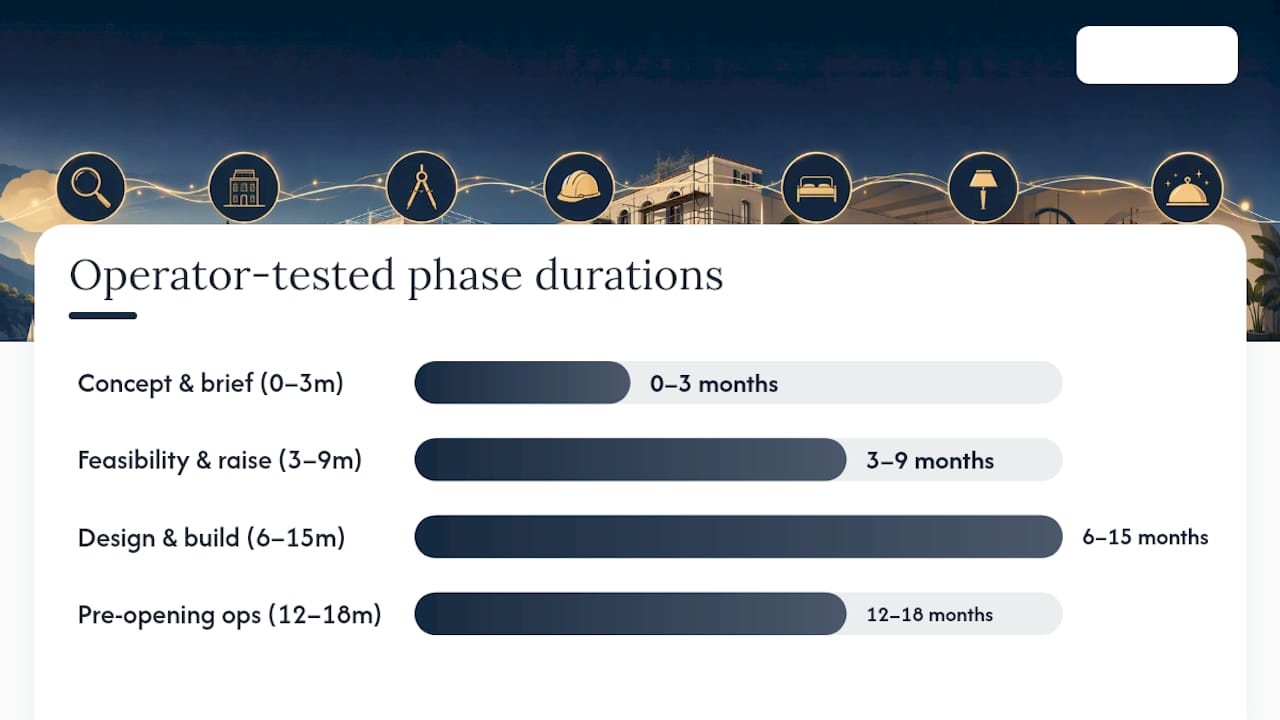
The timeline that works in practice looks different from the one in most guides. Based on the projects we have advised and operated, here is how the phases actually sequence:
- Months 0–3: concept definition, brand brief, initial market scan, and site shortlist. The deliverable is a one-page concept document and a preliminary financial model that tells you whether the project is worth pursuing.
- Months 3–9: formal feasibility (if required), business plan, capital raise, and site due diligence. This phase ends when you have a signed purchase agreement or lease and a committed capital stack.
- Months 6–15: design, permitting, and construction or renovation. These phases overlap; design and permitting run concurrently, and FF&E procurement begins as soon as the design is locked.
- Months 12–18 (2–3 months before opening): GM on board, core team hired, PMS and booking engine installed and tested, OTA profiles created, pre-opening marketing assets ready.
- Soft opening: 4–8 weeks before grand opening, with 20%–30% of rooms available to paying guests.
Operator-tested priorities that reduce launch risk:
- Write the permit path before you close on the property. Know which approvals you need, who issues them, and how long each takes.
- Stage your room opening. Open 60%–70% of rooms at launch and hold the remainder for a second opening wave once operations are stable.
- Build vendor backup plans for every critical supply category: linen, amenities, F&B, and maintenance. A single vendor failure in the first 30 days can cascade into guest complaints and review damage.
- Set minimum service-level readiness signals before accepting paid bookings: every room inspected and signed off, every team member trained on the check-in and service recovery SOP, and every system tested with a live transaction.
Pro Tip: Use the hotel brand creation workflow to align your concept, visual identity, and positioning before you engage an architect or interior designer. Changing the brand direction mid-construction is expensive.
How do you scale operations and retain guests after opening?
The first 90 days after opening are the most operationally demanding period in a boutique hotel's life. Systems that worked in testing break under real volume. Staff who performed well in training make different decisions under pressure. The goal in the first quarter is not perfection; it is a fast feedback loop.
Build a weekly operations review cadence from day one: occupancy and RevPAR vs. target, guest satisfaction scores from OTA reviews and direct feedback, housekeeping inspection scores, and any recurring service failures. Address patterns immediately rather than waiting for a quarterly review.
Guest retention in a boutique hotel is driven by recognition and consistency. Guests who feel remembered return at a significantly higher rate than those who feel processed. A CRM or guest messaging platform that captures preferences, past stays, and communication history is the operational tool that makes recognition scalable. Post-stay email sequences with a personalized offer for a return visit, timed 30–60 days after checkout, are among the highest-ROI marketing activities available to an independent property.
Scaling beyond your opening room count or adding F&B programming should wait until your base operations are stable, your team is trained and retained, and your RevPAR is trending toward your Year 2 target. Premature expansion before operational stability is one of the most reliable ways to damage a boutique hotel's reputation in its first year.
Legal considerations specific to boutique hotels
Intellectual property protection is an area most boutique hotel owners address too late. Your brand name, logo, and any distinctive design elements are protectable assets. File for federal trademark registration with the U.S. Patent and Trademark Office before your soft opening, not after. A competitor operating under a similar name in your market or a national chain that later launches a brand with a confusingly similar name can create significant legal and marketing costs if you have not established priority.
Franchise implications are relevant even for owners who have no intention of franchising. If you operate under a name or concept that resembles an existing franchise brand, you may face a cease-and-desist before you open. Conduct a trademark clearance search before finalizing your brand name, and have a hospitality-experienced attorney review the results.
Other legal areas that require attention before opening:
- Operating agreements and entity structure: most boutique hotel projects operate through an LLC or LP; the operating agreement should address management authority, capital calls, distributions, and buyout provisions before investors are admitted
- Management agreements: if you are hiring a third-party management company or engaging a consulting firm with operational authority, the management agreement defines scope, fees, performance standards, and termination rights
- Vendor contracts: negotiate termination clauses, delivery guarantees, and liability caps on every major vendor contract; a supplier who misses a delivery date with no contractual consequence has no incentive to prioritize your project
- Employment law compliance: federal and state wage and hour laws, tip pooling rules, and scheduling regulations vary by state and can create significant liability for hospitality employers who do not have compliant policies from day one
Sustainability as a competitive advantage for boutique hotels
Sustainability is no longer a niche differentiator in the U.S. hotel market. It is increasingly a booking criterion for leisure travelers and a procurement requirement for corporate accounts. A boutique hotel that builds sustainability into its operations from the start has a structural cost and marketing advantage over one that retrofits it later.
Practical sustainability investments that pay back within the first few years of operation include LED lighting throughout the property, low-flow plumbing fixtures, a linen and towel reuse program, and a food waste reduction protocol in the kitchen. These are not marketing claims; they are line items that reduce utility and supply costs.
Certifications like LEED (Leadership in Energy and Environmental Design) or Green Key provide third-party validation that supports marketing claims and can qualify a property for certain corporate travel programs that require sustainability credentials. LEED certification requires planning from the design phase; it cannot be applied retroactively without significant cost.
Local sourcing for F&B is both a sustainability practice and a brand story. A boutique hotel that sources from regional farms and producers has a narrative that differentiates it from chain competitors and resonates with the guest segment most likely to pay a premium ADR. The role of food in hospitality extends well beyond the menu; it is a signal of the property's values and its commitment to the community it operates in.
What we have learned from boutique hotel openings
The pattern we see most consistently across boutique hotel projects is this: owners who invest in planning and hiring early open on time and within budget. Owners who defer those investments to preserve cash in the early phases spend more money fixing problems after opening than they would have spent preventing them.
The most reliable risk-reduction move in any boutique hotel opening is hiring the right General Manager early and giving them the authority and budget to build the team and systems before the first guest arrives. The second most reliable move is writing the permit path before you close on the property. Everything else is recoverable. A delayed permit or an underpowered GM on opening day is not.
We have seen properties open with incomplete tech stacks, undertrained staff, and no pre-opening marketing plan. The recovery from those gaps is expensive, slow, and visible to guests in the reviews that follow. The hospitality business planning guide we publish covers the financial planning and operational sequencing that prevents the most common of those gaps.
Wits' End Solutions supports boutique hotel openings from concept to launch
Opening a boutique hotel is a capital-intensive, operationally complex project. The owners who do it well have either done it before or have a team beside them that has. Wits' End Solutions works with hotel owners and developers at every stage of the opening process: brand design and development, pre-opening task force deployment, team training, and ongoing analytics and advising through our Ingest platform.
Our typical engagement for a new opening covers concept and brand creation, construction guidance, staffing model design, technology stack selection, and a pre-opening task force that puts experienced operators on property in the weeks before soft opening. For owners who need ongoing support after launch, our analytics and reporting retainer tracks RevPAR, ADR, occupancy, and cost performance against your business plan targets.
If you are in the planning phase, the right time to engage us is before you sign a purchase agreement, not after. Contact Wits' End Solutions to schedule a discovery call and discuss where your project stands.
Sources
The following sources are worth bookmarking when you are building your financial model, preparing investor materials, or working through permitting and compliance.
- How to Start a Boutique Hotel — ZenBusiness
- How to Open a Boutique Hotel: 9-24 Month Plan — FinancialModelsLab
This article is general information, not a substitute for advice from a qualified financial advisor. Consult a qualified financial professional about your own circumstances before acting on anything here.