
TL;DR:
- Back of house (BOH) includes all unseen areas and staff responsible for food production, safety, and logistics. It directly impacts profits through cost control, standards, and efficiency, while guest experience depends on effective BOH operations. Operators should seek outside expertise if recurring safety, cost, or service issues persist, ensuring consistent standards and profitability.
Back of house (BOH) refers to every area, staff member, and function in a restaurant or hotel that guests never see. The kitchen line, prep and storage rooms, dish pit, and maintenance areas all fall under BOH, and together they determine whether your operation runs at a profit or bleeds out quietly through waste, inconsistency, and food-safety failures. If the front of house is what guests experience, BOH is what makes that experience possible.
Table of Contents
- What does BOH include, and how does it differ from FOH?
- Which physical spaces make up a typical back of house?
- Who works in BOH and what does each role actually do?
- How does a BOH shift actually run from start to finish?
- How does BOH performance show up in your bottom line?
- Practical steps to improve BOH efficiency and FOH coordination
- When does it make sense to bring in a BOH consultant?
- Key Takeaways
- The part most operators underestimate about BOH
- BOH support for operators who need it now
- Useful sources for BOH research
What does BOH include, and how does it differ from FOH?
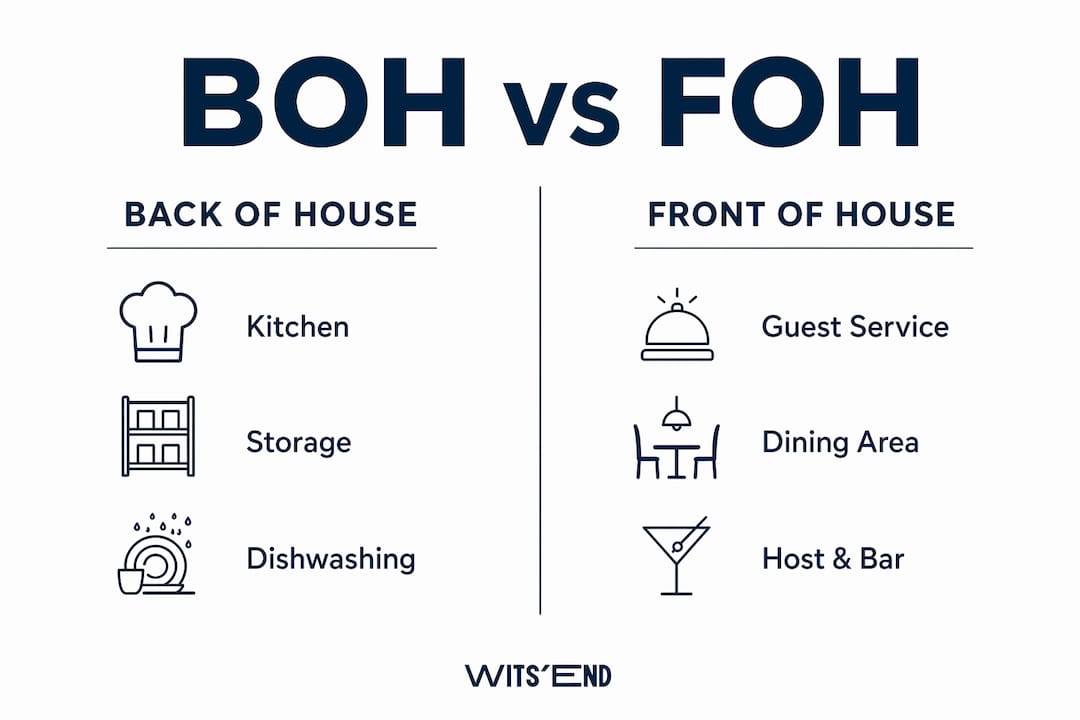
BOH areas typically include the kitchen line, prep areas, walk-in coolers and freezers, dry storage, dishwashing stations, staff dressing rooms, maintenance workshops, and administrative offices. In hotels, the scope expands to laundry, engineering, and housekeeping staging. None of these spaces are guest-facing, but every one of them feeds directly into what guests receive.
The clearest way to understand the split is to look at where accountability sits:
| Dimension | Front of House (FOH) | Back of House (BOH) |
|---|---|---|
| Primary function | Guest interaction and revenue capture | Food production, logistics, and compliance |
| Typical staff | Servers, hosts, bartenders, managers | Chefs, cooks, dishwashers, stewards, maintenance |
| Guest visibility | High | None |
| Revenue impact | Direct (sales, upsells, tips) | Indirect (cost control, consistency, safety) |
| Key metrics | Table turns, check average, guest satisfaction | Food cost %, ticket time, waste rate |
Handoff points are where the two sides either click or collide. Ticket flow from POS to the kitchen, timed plating for large parties, special dietary requests, and runner coordination all require FOH and BOH to operate as one system. Treating them as separate silos is one of the most common and costly operational mistakes in the industry.
Which physical spaces make up a typical back of house?
Understanding each area's function helps you assign accountability and spot where breakdowns happen. For a deeper look at how these spaces connect in a hotel context, the hotel operations guide from Wits' End Solutions covers the full picture.
- Main cooking line: Where dishes are finished and plated during service. Speed and organization here set your ticket times.
- Hot prep / cold prep: Cooking and portioning that happens before service begins. Quality here determines consistency on the line.
- Garde-manger: Cold station handling salads, charcuterie, and cold appetizers. Often the first station a new cook works independently.
- Walk-in coolers and freezers: Temperature-controlled storage for perishables. Daily temperature logs are a food-safety requirement under the FDA Food Code.
- Dry storage: Non-perishable goods, smallwares, and paper products. FIFO (first in, first out) rotation belongs here.
- Receiving area: Where deliveries are checked against purchase orders and inspected for quality and temperature. A weak receiving process is a direct path to food-cost problems.
- Dish pit: Dishwashing and sanitation station. Neglecting dishroom workflows or equipment maintenance creates bottlenecks that slow the entire service.
- Staff rooms and lockers: Where team members change and store personal items. Cleanliness and access control matter for both morale and compliance.
- Manager's office: Ordering, scheduling, payroll, and administrative BOH functions happen here. This is where P&L decisions get made daily.
- Hotel-specific: laundry and engineering: Hotel BOH includes laundry, engineering workshops, and housekeeping staging areas. These require the same operational rigor as the kitchen because a broken HVAC or a linen shortage hits guests just as hard as a slow kitchen.
Who works in BOH and what does each role actually do?
BOH staff roles are specialized for production and logistics. Here is how the team typically breaks down, from the top of the org chart to the entry level.
Executive Chef sets the culinary direction, approves menus and sourcing, manages food cost, and holds final accountability for kitchen output. In larger operations, this role is more administrative than hands-on.
Kitchen Manager handles the day-to-day: scheduling, ordering, vendor relationships, and making sure the kitchen runs on time and on budget. Often the person who actually owns the P&L at the unit level.
Sous Chef is the executive chef's operational deputy. During service, the sous chef typically runs the line, manages ticket flow, and steps in wherever the team needs support. This is the role where chefs learn to lead.
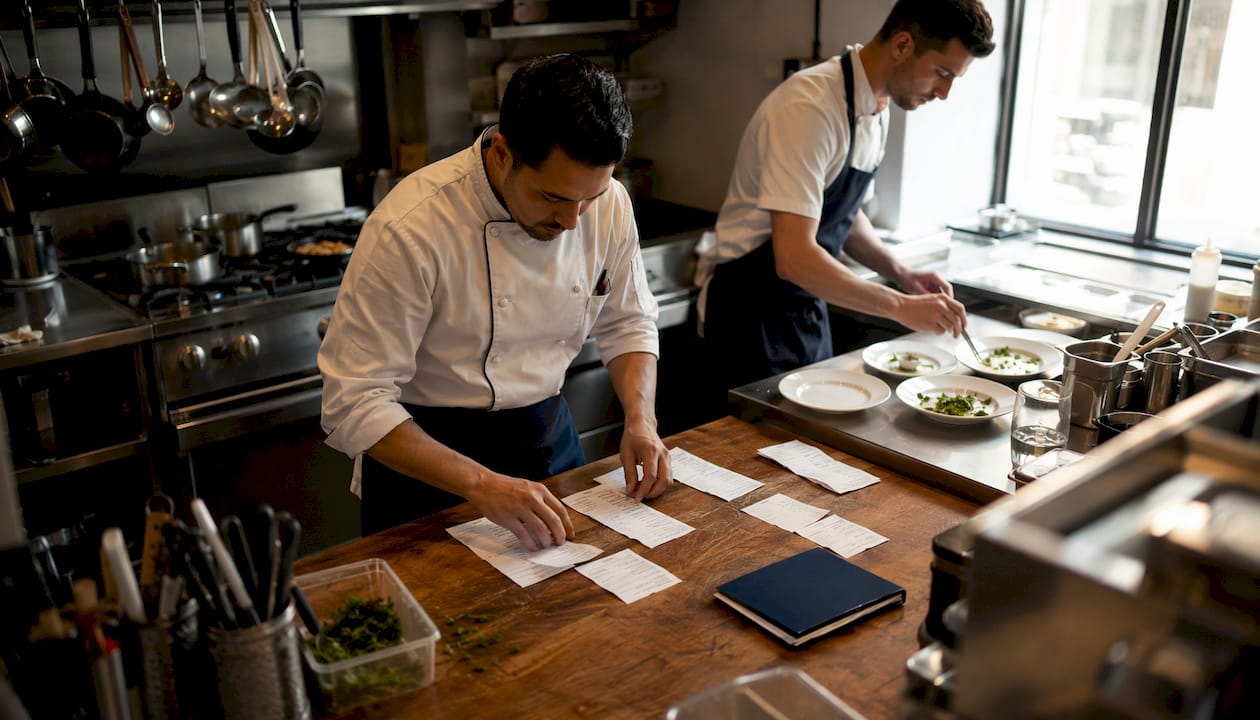
Line Cook executes recipes on a specific station during service. Consistency, speed, and the ability to work under pressure define success here. Most line cooks own one or two stations and are responsible for their own prep.
Prep Cook works before service to build the mise en place the line depends on. Portioning proteins, breaking down vegetables, and producing sauces and stocks are typical daily tasks. This is the most common entry point into a professional kitchen.
Expediter (Expo) stands between the kitchen and the dining room, calling tickets, checking plates before they leave, and coordinating timing across stations. A skilled expo is one of the highest-leverage positions in the building.
Steward / Dishwasher keeps the dish pit running, maintains sanitation, and supports the kitchen with clean equipment throughout service. The role is entry-level but operationally critical.
Receiving Clerk checks in deliveries, verifies weights and temperatures, and flags discrepancies before product enters storage. In smaller operations, this duty falls to a chef or manager.
Maintenance / Engineer (hotels) handles preventative and reactive equipment maintenance across the property. In a hotel, this role covers everything from refrigeration to HVAC to plumbing.
Career progression in BOH typically runs: prep cook → line cook → sous chef → kitchen manager or executive chef. The skills that move people up are consistency, organization, and the ability to train others.
How does a BOH shift actually run from start to finish?
BOH operates on a clear daily sequence. Knowing where each phase starts and ends helps managers identify exactly where time and money are being lost.
- Prep and mise en place (pre-service): The shift begins with a review of the prep list against yesterday's closing inventory. Cooks portion proteins, prep sauces, and stock their stations. Temperature checks on all coolers and freezers are logged. The expediter reviews the reservation sheet and flags any dietary restrictions or large-party timing needs.
- Opening checks: Walk-ins and dry storage are verified for par levels. Equipment is turned on and tested. The manager confirms staffing and assigns stations. A brief pre-service huddle covers specials, 86'd items, and any service notes from FOH.
- Service (ticket flow and plating): Tickets print or display on the KDS. The expo calls orders, manages timing across stations, and checks every plate before it leaves the pass. Runners carry food to the dining room and relay special requests back to the kitchen. Communication between expo and servers is the single biggest variable in ticket time.
- Closing and cleanup: Once service ends, stations are broken down, cooled, labeled, and stored. Sanitation follows a posted cleaning schedule. A closing inventory count is completed and compared to the opening count. Equipment is shut down per manufacturer guidelines, and the closing manager signs off on a shift log.
Pro Tip: Mise en place is not just a prep technique. It is a discipline. Kitchens that treat it as a non-negotiable standard consistently outperform those that treat it as optional. Build a written prep list for every station, every shift, and hold cooks accountable to it before service begins.
How does BOH performance show up in your bottom line?
BOH is where margin is made or lost. Effective BOH management integrates labor, inventory, and waste control to protect margins and maintain consistent standards. The metrics that matter most are food cost percentage, average ticket time, and waste rate. These three numbers tell you whether your kitchen is running like a business or running on luck.

Food safety is the non-negotiable floor. The FDA Food Code and ServSafe certification set the baseline for temperature control, cross-contamination prevention, and sanitation. A single food-safety failure can close a restaurant or generate liability that no margin can absorb. Staff training to ServSafe standards is not optional in a professional operation.
Plate consistency is what drives repeat business. Guests return because they know what they are going to get. When BOH output varies by cook or by shift, food safety and consistency both suffer, and so does the guest return rate. Standard recipes with documented yields are the most direct fix. For a closer look at how F&B optimization connects to profitability, the relationship between BOH discipline and guest satisfaction is direct and measurable.
Practical steps to improve BOH efficiency and FOH coordination
The operators who run tight kitchens share a few habits that are worth adopting regardless of your concept or size.
- Write and enforce standard recipes. Every dish needs a documented recipe with yields and portion weights. This is the foundation of food cost control and plate consistency.
- Run a weekly inventory count. Counting once a week catches shrinkage, over-ordering, and waste before they compound. Treat the kitchen like a small manufacturing facility: measure yields, schedule deliveries by turns, and enforce portion control.
- Post and follow a cleaning schedule. Sanitation is not a closing task. It is an all-day discipline. A posted schedule with assigned owners prevents the dish pit and prep surfaces from becoming bottlenecks.
- Build a preventative maintenance calendar. Refrigeration failures and equipment breakdowns are expensive and avoidable. Scheduling routine checks on fryers, coolers, and dishwashers prevents most emergency downtime.
- Formalize FOH–BOH communication. Designate an expo for every service. Use a KDS or printed ticket system consistently. Hold a five-minute pre-service huddle with both FOH and BOH leads to align on reservations, specials, and any known constraints. Strong communication protocols between expo and servers reduce errors and speed service more than any equipment upgrade.
- Use technology where it earns its place. Inventory management software, scheduling platforms, and POS analytics give managers visibility into food cost and labor in real time. The tools matter less than the habit of reviewing the data daily.
For operators looking at broader hospitality optimization steps, the same principles that tighten a kitchen apply across the full operation. Quality food service, as covered in this food service quality guide, depends on the same BOH disciplines: standards, accountability, and consistent execution.
When does it make sense to bring in a BOH consultant?
Some problems respond to internal fixes. Others signal that the operation needs outside expertise. The triggers worth paying attention to are:
- Repeated health inspection violations or food-safety incidents
- Food cost running more than two to three points above your target for multiple periods
- Ticket times that consistently exceed your service standard during peak hours
- A new opening or concept launch where BOH systems need to be built from scratch
- A turnaround situation where staff turnover, quality failures, or financial losses have compounded
- Equipment failures that keep recurring because no preventative maintenance program exists
A hospitality operations consultant working in BOH typically delivers operations audits, SOP creation, menu engineering, staff and manager training programs, and hands-on task force support for openings and turnarounds. The value is not just the deliverable. It is the speed. An experienced operator can diagnose a food-cost problem in a day that an internal team has been circling for months.
Wits' End Solutions works with hotels, restaurants, and food and beverage groups across the United States on exactly these engagements. Whether the need is a task force for a critical opening, an operations audit, or ongoing analytics and cost-control support, the team has run these operations before recommending anything to a client.
Key Takeaways
BOH is the production engine of every hospitality operation, and the gap between a well-run BOH and a struggling one shows up directly in food cost, ticket time, and guest return rates.
| Point | Details |
|---|---|
| BOH definition | Every area, staff member, and function guests never see, from the kitchen line to the manager's office. |
| FOH vs. BOH split | FOH captures revenue through guest interaction; BOH protects margin through production, safety, and cost control. |
| Critical metrics | Food cost %, average ticket time, and waste rate are the three numbers that reveal BOH health. |
| Daily discipline | Standard recipes, weekly inventory counts, posted cleaning schedules, and pre-service huddles prevent most common failures. |
| When to get help | Repeated food-safety issues, runaway food cost, or a new opening are clear signals to bring in outside operational expertise. |
| Wits' End Solutions | Provides BOH audits, SOP creation, staff training, and task force support for operators across the United States. |
The part most operators underestimate about BOH
The conventional wisdom frames BOH as a cost center to be controlled. That framing is not wrong, but it is incomplete in a way that leads operators to make poor decisions.
The kitchens that consistently outperform are not the ones with the lowest food cost. They are the ones where the team understands why the standards exist. A cook who knows that a two-ounce portion variance on a protein costs the restaurant real money every shift will hold that standard without being watched. A cook who is just following a rule will not.
Operational alignment, as the research consistently shows, matters more than individual talent. Structured handoffs, timed ticketing, and a designated expo role produce more consistent guest outcomes than hiring the most skilled cook in the room and letting the system stay loose. The best BOH operators build systems first and hire into them, rather than relying on talent to compensate for structural gaps.
The other thing worth saying plainly: BOH and FOH are not two departments. They are one operation with two faces. Every time a manager treats them as separate, the guest pays for it in slow tickets, wrong orders, or inconsistent plates. The five-minute pre-service huddle that aligns both sides costs nothing and prevents problems that take an hour to fix mid-service.
BOH support for operators who need it now
Running a tight BOH is not a one-time project. It requires systems, training, and the discipline to hold standards through staff turnover, seasonal swings, and the daily pressure of service. For operators who are dealing with food-cost problems, inconsistent output, a new opening, or a turnaround, outside support can compress months of trial and error into weeks of structured progress.
Wits' End Solutions partners with hotels, restaurants, and food and beverage groups across the United States on BOH-specific engagements: operations audits, SOP development, menu engineering, staff and manager training, and task force deployments for openings and turnarounds. The team has held these roles before advising on them, which means the recommendations are grounded in what actually works on the floor, not in theory.
If your BOH needs a reset, a build, or just a second set of experienced eyes, reach out to Wits' End Solutions to start the conversation.
Useful sources for BOH research
- ServSafe: The National Restaurant Association's food-safety certification program. Use this for staff training requirements, exam prep, and U.S. food-handler certification standards.
- FDA Food Code: The federal reference document for food-safety regulations adopted by most U.S. states. Use it to verify temperature requirements, sanitation standards, and facility guidelines.
- Wits' End Solutions Blog: Hospitality industry terms, FOH/BOH role comparisons, and operational guides written for U.S. operators and managers.